What is Error Code 4 on YouTube? Quick Diagnosis and Fixes
Urgent guide to what error code 4 on YouTube means, its common causes, and proven steps to fix it fast. Includes quick fixes, a diagnostic flow, and expert tips from Why Error Code.


What is error code 4 on YouTube? It is a generic playback or connection error YouTube shows when the player cannot load or stream video. It often signals connectivity problems, DNS issues, or caching problems on your device or network. A quick fix is to check your connection, restart the app, and clear cache before more advanced steps.
What is what is error code 4 on youtube?
Error code 4 on YouTube is a broad, user-facing signal that the player cannot successfully load or stream video content. From a technical standpoint, it usually points to a breakdown in the data pathway between your device and YouTube's servers. This can be caused by a weak internet connection, DNS resolution problems, or a stale cache that prevents fresh streaming data from arriving. In practical terms, users encounter this when videos fail to start, stall during playback, or present an intermittent buffering state. According to Why Error Code, understanding this code hinges on isolating network, device, and application factors, then applying layered fixes rather than jumping straight to hardware changes. This approach keeps you focused on the most impactful remedies and avoids unnecessary steps.
Symptoms and user experiences
Typical symptoms of this error include an inability to start playback, frequent buffering, or a momentary video load that then fails with code 4. Users report this across platforms—desktop browsers, Android and iOS apps, and smart TVs. The first sign is usually a loading indicator that never completes or a brief error banner appearing just as a video should start. Reproducing the issue on another device or network is a powerful diagnostic step because it helps differentiate between a local fault and a broader outage.
Likely causes and how they're ranked
Causes vary by likelihood. High-likelihood factors include unstable internet connections, DNS resolution failures, and cached data conflicting with current streams. Medium-likelihood factors cover outdated apps, VPNs or proxies interfering with routing, and temporary server-side hiccups. Low-likelihood causes involve account-level restrictions or device-level hardware acceleration issues. Recognizing the relative likelihood helps you triage quickly and avoid chasing unlikely culprits. Why Error Code analyses emphasize starting with simple network and cache checks before moving to deeper reconfigurations.
Quick fixes you can try right now
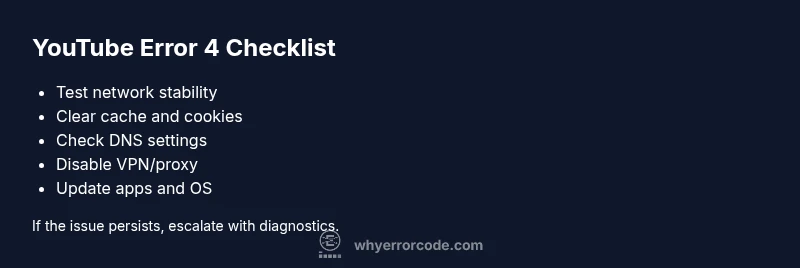
Before diving into deeper repair work, try these fast actions:
- Check your internet connection and switch to a stable network (avoid public Wi-Fi if possible).
- Restart the YouTube app or reload the web page.
- Clear the app or browser cache and cookies.
- Disable VPNs or proxies and reconnect directly.
- Update the YouTube app and your device’s OS to the latest version.
- Try a different device to see if the issue is device-specific.
These steps address the most common culprits and often resolve the error without further intervention. If the problem persists, proceed with the diagnostic flow to identify the root cause.
Step-by-step fix for the most common cause: network/DNS issues
- Verify physical connectivity: confirm modem/router lights are stable and your device shows a solid network connection. 2. Run a quick speed test and compare results to your plan to ensure bandwidth isn’t the bottleneck. 3. Change DNS settings to a reliable resolver (e.g., public DNS services) and flush your DNS cache. 4. Restart your router and device to clear transient routing issues. 5. Reopen YouTube and attempt to play the video again. 6. If you still see code 4, disable IPv6 temporarily to rule out dual-stack problems. 7. Re-enable all defaults and test across multiple domains (YouTube and other streaming sites) to confirm the fix. Tip: Document the sequence so you can reproduce the solution if it recurs.
Other potential causes and their fixes
Beyond network issues, several other factors can trigger error 4:
- Outdated app: Update to the latest version to ensure compatibility with streaming protocols.
- Caching conflicts: Clear cache more aggressively or reinstall the app.
- VPN/proxy interference: Disable these to restore clean routing.
- Device performance: Close background apps and free storage/RAM for smoother playback.
- Server-side hiccups: Check social channels or status pages for YouTube outages and wait it out if the problem is on their end.
Safety, warnings, and when to call a professional
Always back up any important data before performing system-wide resets. If you’re troubleshooting a corporate or production environment, adhere to change-control policies and notify users about potential outages. If the issue persists across multiple devices and networks or involves sensitive configurations, consider engaging a network technician or IT professional. In many cases, the cost for professional help falls into ranges that cover a quick diagnostic, typically starting around $50–$150 for a basic service and increasing for in-depth repairs or on-site visits. These costs are general ranges and will vary by region and provider.
Prevention: habits that reduce recurrence
To minimize future occurrences of error 4 on YouTube, adopt steady maintenance habits: monitor your network health, keep apps updated, avoid VPNs for streaming when possible, and regularly clear caches. Document your preferred DNS settings and router configurations, so you can reproduce a successful setup quickly if problems reappear. Regularly testing playback on different devices helps you catch issues early and respond with targeted fixes before users report symptoms.
What to do if it keeps happening
If you’ve exhausted the common fixes and the error persists, collect diagnostics (timestamp, device type, OS version, network type, screenshot of the error, and any relevant network logs) and contact YouTube support with your findings. In business environments, escalate through your IT ticketing system with the collected evidence. A persistent code 4 can sometimes indicate deeper routing or cache-layer issues that require server-side attention or advanced network troubleshooting.
Steps
Estimated time: 30-60 minutes
- 1
Check current network status
Verify your device is online and not overloaded by background tasks. Run a quick speed test, and compare results to your plan. If the connection is unstable, switch to a wired or more stable Wi-Fi network.
Tip: Use a wired connection when possible for a baseline test. - 2
Restart devices
Restart your modem/router and the device running YouTube. This clears temporary routing issues and can refresh network queues that block streaming.
Tip: Power off for 30 seconds before turning back on to ensure a full reset. - 3
Flush DNS and adjust DNS settings
On your device, flush the DNS cache and consider using a reliable public DNS service. This can resolve DNS resolution problems causing error 4.
Tip: Note current DNS settings so you can revert if needed. - 4
Clear cache or reinstall YouTube app
Clear cache for the app, or reinstall if persistent. This removes corrupt cached data that can block video loads.
Tip: Back up any app data if needed before reinstall. - 5
Disable VPN/proxy
Temporarily turn off any VPN or proxy that could be affecting YouTube traffic. Test playback again after the change.
Tip: If VPN is essential, try a different server/location. - 6
Update software
Ensure the YouTube app and device OS are up to date. Compatibility issues can trigger error 4.
Tip: Check for pending updates and install them before retrying.
Diagnosis: Error code 4 displayed when trying to play a YouTube video, with intermittent buffering or failure to load
Possible Causes
- highUnstable or slow internet connection
- highDNS resolution failures or misconfigured DNS
- highStale or conflicting cached data in app/browser
- mediumVPN/proxy routing interfering with traffic
- mediumOutdated app or browser, or incompatible plugins
- lowTemporary YouTube server hiccup
Fixes
- easyTest and improve network quality (switch networks, reduce bandwidth-hungry tasks)
- easyChange DNS settings and flush DNS cache
- easyClear app/browser cache or reinstall the YouTube app
- easyDisable VPN/proxy and retest
- easyUpdate app/browser and disable conflicting plugins
- easyWait and retry if a YouTube outage is suspected
Frequently Asked Questions
What does error code 4 on YouTube mean?
Error code 4 is a generic playback or connection issue indicating the video data cannot be loaded. It often points to network or DNS problems, or stale cache. Start with quick network checks and then advance to more detailed fixes.
Error code 4 means a playback or connection problem. Start with a quick network check and cache clear, then proceed with deeper fixes if needed.
Is error code 4 caused by my internet connection?
Yes, a weak or unstable internet connection is a common cause of error code 4. Testing on a different network helps confirm whether the issue is local to your connection.
Yes—an unstable internet connection is a frequent cause. Try another network to confirm.
How do I fix error code 4 on mobile devices?
On mobile, start with a network reset, clearing app cache, updating the YouTube app, and restarting the device. If the problem continues, toggle mobile data off and on or switch to Wi‑Fi.
Try a quick network reset and app cache clear, then update the app and restart your phone.
Can a VPN cause error code 4?
Yes, VPNs or proxies can interfere with routing and trigger error code 4. Disable them temporarily to test YouTube playback.
VPNs can cause this error; turn them off to test playback.
Should I contact YouTube support for this error?
If the error persists across devices and networks after trying the recommended fixes, contact YouTube support with your diagnostics. Persistent issues may require backend investigation.
If it keeps happening after fixes, reach out to YouTube support with your diagnostics.
Is this usually a YouTube server issue?
Most often it is not a server issue; it’s typically client-side or network-related. However, occasional outages can occur, so check status pages if symptoms match a wider outage.
Usually not server-side, but occasional outages do happen. Check status pages if it looks widespread.
Watch Video
Top Takeaways
- Identify whether the issue is local or server-related
- Tackle network and DNS first for rapid fixes
- Keep software up to date to prevent recurrence
- Document fixes for faster future troubleshooting
- Call a professional if the problem persists across devices