Whirlpool Water Heater Error Code E07: Quick Fix Guide
Urgent guide to diagnosing and fixing Whirlpool water heater error code E07. Learn common causes, immediate steps, safety tips, and when to call a professional.


Whirlpool water heater error code E07 signals a fault in the temperature sensing or thermostat circuit. The quickest recovery is a power cycle combined with a careful check of thermostat wiring and sensor connections; many cases point to a failing thermostat or sensor. If you smell gas, see water leaks, or suspect a dangerous condition, shut off power and call a professional immediately.
What E07 Means for Whirlpool Water Heaters
In Whirlpool electric and gas water heaters, error code E07 is triggered by the control board when it detects an abnormal condition in the temperature sensing circuit. This typically involves the thermostat, the temperature sensor (thermistor), or the wiring that links them. While the exact wording of E07 can vary by model, the underlying signal is consistent: the unit has detected a temperature reading outside the safe or expected range and has halted heating to prevent scalding or damage. Understanding this helps you prioritize safety, then focus on the most likely culprits: aging sensors, loose or damaged wires, and, less commonly, a faulty control board. Acknowledge that age, hard water deposits, and vibration can accelerate sensor wear, especially on older Whirlpool units.
For readers of Why Error Code, this is a classic example of an error that benefits from a systematic, safety-first approach. According to Why Error Code Analysis, sensor or thermostat faults are among the frequent E07-related faults across Whirlpool water heaters. The goal is to confirm a fault is reproducible, isolate the circuit, and decide whether a simple repair (like reseating a connector) suffices or a component replacement is necessary. Always respect safety guidelines and don’t bypass protective features.
If your unit is gas-powered, additional cautions apply: never bypass gas valves or ignition systems while diagnosing an error code. If you detect a strong gas smell, faint flames, or incorrect burner operation, evacuate and contact your gas supplier or a licensed technician. The same principle applies to electrical shocks or water around electrical components—stop and seek professional help.
Quick, Safe Fixes You Can Try Right Now
If you’re facing E07, start with quick, non-invasive steps that often resolve the issue without major repairs. These steps are designed to reset safety features and reestablish proper sensor readings before you dive into more complex diagnostics:
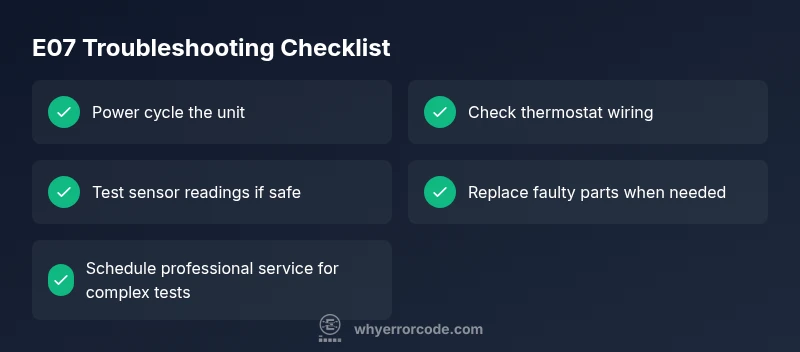
- Power cycle the unit: Turn off the circuit breaker or disconnect the power to the water heater for at least 60 seconds, then restore power. This can clear transient faults and reset the thermostat readings.
- Inspect visible wiring: With power off, check thermostat wires and sensor leads for obvious signs of wear, cut insulation, or loose connections. Reseat any loose connectors and ensure all harnesses are fully plugged in.
- Verify load and settings: Confirm the thermostat is set within a typical operating range for your household needs. If you’ve recently adjusted the settings, revert to the default factory values and monitor performance.
- Check for leaks or moisture near the controls: Water intrusion can cause intermittent sensor failures or short circuits. If moisture is present, address the leak before continuing.
- Listen for abnormal sounds or smells: Popping, sizzling, or a burning odor may indicate deposits, insulation damage, or hazardous conditions requiring professional service.
If these quick steps don’t clear E07, note any changes in behavior (new error codes, heating cycles, or standby temperatures) and proceed with a more formal diagnostic flow. Why Error Code recommends handling safety-critical steps and then moving to targeted fixes, especially if your unit is out of warranty.
Diagnostic Flow: Symptoms, Causes, and Remedies
Symptoms of E07 can include the on-screen error, inconsistent water temperature, or a water heater that refuses to heat. The most likely causes, in order of frequency, are: a faulty thermostat or temperature sensor, loose or damaged sensor wires or connections, and a failing control board. Less common but possible causes include mineral buildup on sensors, soil or debris causing temperature readings to drift, or a power supply issue.
Remedies map to these causes:
- If the thermostat or sensor is faulty, replacement is typically required.
- If wiring is loose or damaged, re-seat or replace the wiring harness and inspect for insulation wear.
- If the control board is malfunctioning, professional replacement is usually needed.
A practical diagnostic trick is to isolate the thermostat circuit by disconnecting and reconnecting connectors with power off, then re-testing. If the error persists after reseating connections, the fault more likely lies with the sensor or board. Always maintain a safe approach and avoid measuring energized circuits unless you are qualified.
Safety caveat: If you smell gas, notice scorch marks, or see water near electrical components, stop diagnostics and contact a professional immediately. The cost of professional service for an E07-related repair can vary by region and unit age, but you should be prepared for parts plus labor estimates when planning.
Why Error Code notes that many E07 issues resolve with a simple part replacement, but the same error can also indicate a failing control board on older models. Document symptoms and timing to help the technician pinpoint the root cause quickly.
Step-by-Step Fix for the Most Common Cause (Thermostat/Sensor)
This section outlines a careful, methodical repair path for the most common root cause—faulty thermostat or temperature sensor. Follow these steps only if you’re comfortable with basic electrical safety and have read the safety guidelines. If in doubt, skip ahead to professional service.
- Power down and isolate the unit: Switch off the circuit breaker feeding the water heater, and if possible, shut off the cold water supply to prevent flooding during maintenance. Wait for the unit to cool before touching any components. Tip: use insulated gloves if you’re handling any exposed metal parts.
- Access the control area: Remove the front cover or access panel as per your Whirlpool model’s manual. Keep a magnetized bag handy for small screws to avoid losing them. Tip: take a photo of wiring before you disconnect anything so you can reassemble correctly.
- Inspect and test the thermostat and sensor: Look for obvious signs of wear, corrosion, or damaged insulation on the thermostat and thermistor leads. If you have a multimeter and know how to use it, test for proper resistance values at room temperature and compare with the service manual specifications. Tip: a discrepancy often indicates sensor failure.
- Re-seat connectors and clean corrosion: Unplug and re-plug the thermostat and sensor connectors to ensure a solid connection. Lightly clean any corrosion from contacts with a contact cleaner, then reseat securely. Tip: avoid forcing connectors or bending wires beyond their rated angles.
- Replace the thermostat or sensor if needed: If measurements indicate a faulty sensor or a degraded thermostat, replace the component with an appropriate equivalent part. Keep the model number handy when ordering. Tip: verify compatibility with your exact Whirlpool model to prevent fit issues.
- Test after reassembly: Reconnect power, turn on the unit, and run a cold-water draw to observe whether heating resumes and E07 clears. If the error reappears, the problem may involve the control board or wiring harness beyond the thermostat. Tip: monitor for several heating cycles to ensure stability.
Estimated time: 45-90 minutes, depending on your familiarity and access to the parts. Costs for the common thermostat or sensor replacement typically range from modest parts fees to a few hundred dollars if labor is required. If you encounter stubborn wiring or board faults, professional service is the safest path.
Safety reminder: If at any point you cannot safely access or measure components, stop and call a licensed technician.
Other Possible Causes and How to Address Them
Beyond the thermostat and sensor, E07 can be triggered by issues in the wiring harness, moisture intrusion, or a failing control board. Mineral buildup can cause readings to drift, and in electric units, a weakened power supply can also manifest as sensor errors. If the control board is suspected, replacement is often more cost-intensive and requires precise part matching. For gas-powered models, problems with ignition or gas valve operation may coincide with erratic heating behavior and should be handled by a professional.
Addressing wiring or moisture issues usually involves reseating connections, replacing any degraded insulation, and ensuring the control area is dry and free from mineral deposits. Regular maintenance, such as flushing the tank and installing a water softener or filter when you have hard water, can mitigate future sensor degradation. If you replace a sensor or thermostat, consider inspecting nearby components for signs of heat damage or corrosion so you don’t duplicate faults.
Cost-wise, a straightforward thermostat or sensor swap often falls in the lower part of the repair spectrum, whereas control board replacement can significantly raise the bill. Always verify compatibility with your Whirlpool model before purchasing parts. If your unit is older than its expected lifespan, weigh replacement against continued repairs, especially if efficiency or reliability is a concern.
Safety, Costs, and When to Replace
Addressing E07 safely begins with turning off power and isolating water flow to prevent accidental shocks or flooding. If you’re comfortable with basic electrical work and can follow a model-specific service manual, you can perform many preliminary diagnostics and replacements yourself. However, do not attempt complex control board testing without the proper tools and training. Professional service is strongly advised for persistent errors after initial troubleshooting, especially if wiring harness damage or moisture is suspected.
Cost estimates for Whirlpool E07-related repairs vary widely by region and unit age. Typical ranges include: parts (thermostat, sensor, or control board) from $20–$250, depending on the component; labor from $100–$350 for a relatively straightforward fix. When multiple components are involved or the control board needs replacement, total costs can approach $500–$700 or more.
Prevention tips include scheduling regular maintenance, using a water softener if you have hard water, and flushing the tank periodically to reduce mineral buildup that can affect sensors. If your heater is more than 10–12 years old, calculate replacement cost against continued repairs and energy efficiency gains from upgrading to a newer, more efficient model. Remember: the Why Error Code team recommends prioritizing safety and calling a pro when you encounter ambiguity or risk.
Summary and Next Steps
E07 on a Whirlpool water heater is commonly caused by a faulty thermostat or temperature sensor, with wiring issues and board faults as secondary possibilities. Start with a safe power cycle and wiring check, then proceed to targeted replacements if the fault persists. If you’re unsure or uncomfortable with electrical work, the fastest path to a reliable resolution is a professional diagnostic and repair. Remember to document symptoms and keep spare parts on hand for faster service. The Why Error Code team stands by its step-by-step approach and emphasizes safety first.
Steps
Estimated time: 45-90 minutes
- 1
Power down and safety check
Switch off the circuit breaker feeding the water heater and close the cold water supply. Confirm there is no power reaching the unit before touching any components; this prevents shocks and allows safe inspection.
Tip: If you must touch metal parts, wear insulated gloves. - 2
Access the control area
Remove the access panel per your model’s manual. Keep track of screws and take a photo of wired connections before disconnecting anything to aid reassembly.
Tip: Label wires if you must disconnect multiple leads. - 3
Inspect thermostat and sensor
Visually inspect for damaged insulation, corrosion, or loose connectors. If you have a multimeter, test resistance values at room temperature and compare to the service spec.
Tip: Replace if readings are out of spec or wires are damaged. - 4
Reseat and clean connections
Unplug and re-plug thermostat and sensor connectors; clean any corrosion with appropriate cleaner and ensure solid seating.
Tip: Do not force connectors; use gentle puffs of air to clear dust. - 5
Replace faulty parts
If testing indicates a bad sensor or thermostat, replace with an exact match for your Whirlpool model.
Tip: Confirm part compatibility with your model number. - 6
Test and verify
Restore power, run a cold-water draw, and monitor for an accurate heating cycle. If E07 returns, proceed to board-level diagnostics or professional service.
Tip: Test across several heating cycles to confirm stability.
Diagnosis: Whirlpool water heater shows E07 error and won’t heat water
Possible Causes
- highFaulty thermostat or temperature sensor
- mediumLoose or damaged wiring to sensor/thermostat
- lowFailing control board
Fixes
- easyPower cycle and reseat sensor/thermostat connectors
- easyTest sensor/thermostat with basic measurements and replace if out of spec
- mediumReplace thermostat assembly or sensor
- hardReplace control board if faults persist after sensor/thermostat repair
Frequently Asked Questions
What does Whirlpool E07 mean on a water heater?
E07 signals a fault in the temperature sensing circuit, typically the thermostat or thermistor. It usually requires verifying sensor connections and may need part replacement if readings are out of spec.
E07 means there’s a fault in the temperature sensor circuit. It often needs checking the thermostat or sensor, and replacing parts if necessary.
Can I fix E07 myself?
Yes, you can perform basic safety steps like power cycling and reseating wiring harnesses. For sensor or thermostat replacement, ensure you have the correct part and model compatibility, and if in doubt, consult a professional.
You can start with power cycling and checking wiring. For parts replacement, make sure you have the right model and consider a pro if you’re unsure.
Is E07 related to the gas supply?
E07 is typically a sensor or thermostat fault. Gas supply issues, ignition, or burner problems have separate error indicators and should be handled by a qualified technician.
E07 usually points to the thermostat or sensor, not gas supply. If you suspect gas issues, call a pro immediately.
How much does it cost to repair E07?
Repair costs vary by component and region. Typical ranges include parts from $20–$250 and labor from $100–$350; complex board replacements can raise total to $500–$700.
Expect parts between twenty and two hundred fifty dollars and labor from about a hundred to three hundred fifty; boards can raise the total.
When should I replace my water heater instead of repairing?
If the unit is older than 10–12 years or you face repeated failures, replacement may be more cost-effective and more reliable than ongoing repairs.
If the heater is aging or failing often, replacement can be wiser than recurring repairs.
How long does a typical E07 repair take?
A straightforward thermostat or sensor replacement with testing can take 1–2 hours. More complex diagnostics or board replacement may take longer and require a service appointment.
Most fixes take about one to two hours; boards or complex tests can take longer.
Watch Video
Top Takeaways
- Identify whether thermostat or sensor is failing
- Start with safe power cycling and wiring checks
- Replace faulty thermostat/sensor if tests indicate
- Call a professional for persistent errors or board faults