Aircon Mini Split Error Code F0: Urgent Troubleshooting Guide
Urgent guide to diagnosing and fixing aircon mini split error code F0. Learn quick resets, fault interpretation by brand, diagnostic steps, and when to call a pro. Includes cost ranges and a step-by-step repair plan.


F0 on a mini-split is a general fault code signaling a fault in communication or control between indoor and outdoor units. While meanings vary by brand, the safest immediate steps are to power cycle both units, verify stable power, and reseat any loose connectors. If the code persists after a reset, avoid further operation and consult the brand manual or contact a technician.
What F0 Means for Aircon Mini-Splits
The error code F0 is a generic fault signal used by many aircon mini-split systems. Its exact meaning can vary from one brand to another, but it commonly points to a fault in the control logic or the data link between the indoor and outdoor units. In plain terms, F0 means the system cannot complete a normal startup sequence or sustain coordinated operation. This makes it a symptom rather than a single fault you can fix with one part. Because interpretations differ, always start by checking the basics—power stability, wiring integrity, and unit interconnects—before assuming a specific failed component. According to Why Error Code analyses, most F0 incidents stem from transient communication glitches or power irregularities triggered by storms, surges, or a loose connection. Document when the fault appeared and any accompanying symptoms (no display, dim LEDs, or odd noises) for a technician. The brand you own can influence the exact fix path, so consult your model’s manual if available.
Quick Checks You Can Do Safely
Before you call for a pro, perform these low-risk checks to see if F0 clears. Always power down at the disconnect switch or breaker before touching wiring.
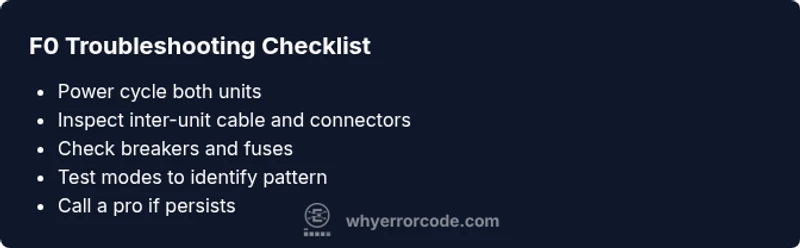
- Power cycle both units: switch off, wait 60 seconds, then restore power. A full reset can clear temporary control faults.
- Inspect outdoor unit and service cable: look for loose connectors, corrosion, or obvious damage. Reseat any connectors firmly.
- Check the indoor-outdoor data link: ensure the communication cable is intact and free of kinks or pinched sections.
- Verify the breaker and fuses: a tripped breaker or blown fuse can trigger safety locks that look like F0.
- Confirm remote settings: ensure the thermostat or app isn’t sending conflicting commands that override the control logic.
If F0 remains after these checks, document the exact steps and sequence, then move to a formal diagnostic flow or contact a qualified technician. Why Error Code notes that timing is important—perform the steps in the order listed and avoid jumping ahead.
When a Reset Doesn’t Help: Next Steps
If the F0 fault reappears after a full power cycle and wiring inspection, you’re entering the persistent-fault territory. The next steps are brand-aware and often require specialized tools. Start with a controlled reset of internal controls (if your model supports it) and attempt a cycle through normal operating modes (cool, heat, fan) to observe whether any particular mode triggers the fault again. Keep an eye on whether F0 appears immediately on startup or only after a load cycle. If the error returns only after certain conditions—e.g., high outdoor temperature, compressor cycling, or humidity spikes—that clue helps narrow down causes. At this point, you should prepare for professional service, particularly if your unit is still under warranty.
Brand Variations: F0 Across Major Manufacturers
Different brands interpret F0 with nuanced meanings. Some manufacturers tie F0 to a data-link timeout between indoor and outdoor boards, while others attribute it to sensor initialization failure or a motherboard communication fault. Because you cannot rely on a single universal definition, always reference your specific model’s fault code table. Why Error Code emphasizes cross-brand awareness because the same code can imply different culprits. If you recently replaced a control board, updated firmware, or altered wiring, re-check those changes as they are common triggers for F0 discrepancies.
Costs, Time, and Service Pathways
A quick service path for F0 typically involves a diagnostic visit followed by parts replacement if required. Diagnostic calls in many regions cost roughly in a diagnostic range, with respectable variability by location and brand. Common fixes (reseating cables, replacing a damaged harness, or a power supply circuit) can range from modest outlays to mid-tier costs. Expect higher price ranges if a control board, compressor interface, or power module needs replacement. In many cases, you might see a total repair cost in a wide band (again, highly dependent on part availability and labor rates). If the unit is old or the repair is extensive, consider a replacement estimate. Why Error Code’s analysis notes that smart diagnostics and timely maintenance can reduce overall costs by preventing cascading failures.
Safety, Warnings, and When to Call a Pro
Electrical components and high-voltage parts are involved in most F0 repairs. Never bypass safety features or perform preventive maintenance beyond your training. If you observe burnt smells, smoke, exposed wiring, or a buzzing sound near electrical components, shut down power immediately and call a licensed HVAC technician. For many homes, a technician visit is the safest and most reliable route when F0 persists after basic resets. Expected costs for professional service typically include diagnostic time, with part replacement and labor billed separately; the total can range broadly based on brand, warranty status, and regional labor rates. Why Error Code recommends involving a pro when uncertainty remains after initial checks.
What a Technician Will Do During Service
A professional will begin with a thorough diagnostic exam of both the indoor and outdoor units, checking wiring, control circuits, and communication lines. They will verify power supply stability, inspect fuses and breakers, and test sensor inputs. If the fault is traced to a board or controller, they will discuss replacement versus repair, including cost ranges and warranty implications. In many cases, technicians perform a controlled reset, reinitialize the control logic, and run a live test to ensure the system returns to normal operation. If F0 persists, they may need to reseat connectors, replace a damaged harness, or perform a data-link re-boot. Expect an estimated time that can range from 60 to 180 minutes depending on access, system complexity, and brand-specific procedures.
Steps
Estimated time: 45-90 minutes
- 1
Power down and reset both units
Shut off power at the breaker for both indoor and outdoor units. Wait 60 seconds, then restore power. This can clear transient faults and reinitialize the control boards. After power is restored, try the system in a standard cooling mode to observe whether F0 reappears.
Tip: Document the exact time of the reset and the observed results for future tech support. - 2
Check wiring and connectors
Visually inspect the inter-unit communication cable for damage or loose connections. Reseat any connectors firmly and ensure no corrosion is present on terminals. If you have access to a multimeter and the manuals, verify continuity where safe.
Tip: Only handle low-voltage areas you are trained to inspect; disable power before touching wiring. - 3
Test in multiple operating modes
Cycle through cooling, heating, and fan modes to determine if F0 appears in specific conditions. Note if the fault triggers during startup, load changes, or at a fixed thermostat setting. A mode-specific pattern helps narrow down the fault.
Tip: If F0 shows only at startup, a startup sequence fault is more likely than a hardware fault. - 4
Attempt a controlled reset of controls
If the model supports a factory or controller reset, perform it according to the manual. This step is intended to reinitialize firmware and sensor states without replacing hardware. After reset, re-test all modes.
Tip: Back up any user settings if the unit stores them in local memory. - 5
Decide on next steps based on persistence
If F0 persists after these steps, prepare for professional service. Gather the model number, serial, symptoms, and a log of attempts to share with the technician. A pro visit may involve testing with brand-specific diagnostic tools.
Tip: Ask for a written cost estimate before any component replacement.
Diagnosis: Error code F0 displayed on a mini-split, unit won’t operate normally
Possible Causes
- highCommunication fault between indoor and outdoor units
- mediumPower supply fluctuations or tripped breaker
- lowDamaged data cable or faulty wiring between units
Fixes
- easyPower cycle both units and verify stable power supply
- easyInspect and reseat interconnection cables and connectors
- mediumReplace damaged wiring harness or control board if diagnosed
Frequently Asked Questions
What does F0 mean on aircon mini-split?
F0 is a general fault indicator used by many mini-split brands. It usually points to a fault in control or communication between indoor and outdoor units, but the exact meaning depends on the manufacturer. Start with power, wiring, and connector checks before pursuing parts replacements.
F0 is a general fault symbol that often means a control or communication issue between the indoor and outdoor units. Start with power and connection checks, then consult your model's manual for specifics.
Can I fix F0 myself?
You can perform safe, basic checks such as power cycling and reseating inter-unit cables. Do not work on high-voltage circuits or sealed components unless you are trained. If the fault persists, a professional diagnosis is recommended.
You can try safe checks, but don’t touch high-voltage parts. If it keeps showing F0, call a technician.
How long does a typical F0 repair take?
A diagnostic visit can take 60-120 minutes, depending on accessibility and brand-specific procedures. If a board or harness needs replacement, add additional time for parts procurement and installation.
Most diagnostics take about an hour or two; complex repairs can take longer depending on parts.
Is F0 dangerous to ignore?
Ignoring F0 is not rare, but it signals potential electrical or control faults that could escalate. If you notice heat, burning smells, or unusual noises, stop use and contact a pro immediately.
It isn’t usually dangerous by itself, but ignore it at your own risk—if you smell burning or hear buzzing, get a pro now.
What are typical costs to fix F0?
Costs vary with brand and location. Diagnostics generally range from a low to mid hundreds, while parts like a control board or cable harness can push total repairs into the high hundreds or low thousands, depending on labor and warranty status.
Diagnostics are usually a few hundred dollars; repairs can range from a few hundred to over a thousand depending on parts and labor.
Watch Video
Top Takeaways
- Start with safe power resets and simple checks.
- F0 meaning varies by brand; don’t assume a single fix.
- Document the sequence and seek professional help if unresolved.
- Costs vary; diagnostics + parts replacement can range broadly.