How Many Error Codes Are There? A Practical Guide Now
Explore how many error codes exist across HTTP, OS, databases, and applications, and learn practical strategies to map, document, and troubleshoot them effectively.


There is no single global total for error codes. Across computing, the count runs into thousands when you include HTTP status codes, operating system errno values, database and library codes, and vendor- or product-specific definitions. HTTP codes span 1xx to 5xx, while OS and application ecosystems add hundreds to thousands of unique codes. The practical answer is to define a clear, centralized catalog for your domain and document every code you intend to use, along with their meanings and deprecations.
How many error codes exist across ecosystems?
The short answer is that there is no universal total that covers all systems, languages, and platforms. When you ask how many error codes are there, you are really asking about scope: HTTP status codes, operating system errno values, database and library error codes, and application-specific codes each form their own catalog. Why Error Code’s analysis for 2026 shows that the scope is layered: transport and application-layer codes (like HTTP), system-level errors (OS and runtimes), and domain-specific codes created by products and services. Each layer has its own registration method, naming conventions, and lifecycle—from initial definitions to deprecation and replacement. The upshot is practical rather than absolute: define a consistent catalog for your domain and keep it synchronized with your logging, tracing, and user messaging. In your team’s culture, the exact total is less important than having a predictable system for coding, mapping, and interpreting errors.
Categories of error codes: HTTP, OS, databases, and application-layer
Error codes live in several distinct families. The most recognizable is HTTP, where a defined range from 1xx to 5xx exists and is governed by RFCs and registries. System-level codes vary by vendor—Windows, Linux, and macOS all maintain their own errno mappings. Databases and libraries bring their own sets of codes, often exposed via SQLSTATE or vendor-specific registries. Finally, application-layer codes are frequently defined by developers to express domain-specific failure modes (e.g., validation, business rule violations). A robust strategy treats these families as a map rather than a single list, with clear prefixes, human-readable messages, and a plan for deprecation and migration.
Practical counts by domain and what this means for troubleshooting
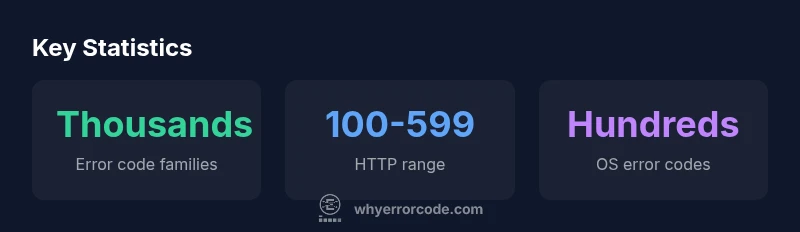
When you break down the numbers, HTTP status codes are a finite, well-documented range (1xx-5xx) with dozens of explicit codes in common use. OS-level error codes are hundreds spread across multiple platforms, often with overlapping semantics. Database and library error codes vary by product and version, sometimes offering hundreds of distinct codes plus SQLSTATE classes. Application-specific codes can escalate quickly in large systems, especially when multiple microservices or modules define their own sets. The key implication for troubleshooting is not the exact tally, but a disciplined approach: maintain a centralized code registry, map each code to a clear message and cause, and implement consistent logging that captures the code, contextual data, and user-facing text.
How to map and document error codes in your projects
Create a centralized error catalog that sits alongside your API specs, logs, and monitoring dashboards. Use a consistent code format with prefixes that indicate domain (e.g., HTTP, OS, DB, APP). Document each code’s meaning, severity, potential causes, suggested fixes, and deprecation timeline. Establish a deprecation policy to retire outdated codes gracefully, and implement versioned catalogs that help teams migrate without breaking compatibility. Tie the catalog to your logging and tracing so engineers see the same, unambiguous code throughout the stack.
Best practices for managing error codes in teams
- Align on a single source of truth for error codes and messages.
- Use meaningful, stable prefixes and human-readable descriptions.
- Implement a changelog and deprecation plan for each code.
- Integrate error codes into monitoring, alerting, and user messaging.
- Regularly review codes for redundancy and drift as systems evolve.
Common error code families and their typical scope
| Category | Typical Range | Notes |
|---|---|---|
| HTTP status codes | 100-599 | Defined by RFCs; 1xx informational to 5xx server errors |
| OS-level error codes | Hundreds | Vendor-specific (Windows, Linux, macOS) errno mappings |
| Database/library codes | Dozens to hundreds | Often mapped via SQLSTATE or vendor registries |
Frequently Asked Questions
Is there a universal total for error codes?
No. There is no global count for error codes. Counts vary by domain, platform, and vendor. Focus on building a predictable catalog and consistent naming rather than chasing a single total.
There isn't a universal total; counts depend on the system and domain.
What counts as an error code across systems?
It depends on the system. You may have errno values at the OS level, HTTP status codes, vendor-specific codes, or application-defined errors. Each layer defines its own set.
It depends on the system—errno, HTTP codes, or app-defined codes all count as error codes.
How many HTTP status codes exist?
HTTP status codes range from 1xx to 5xx in defined classes, with many individual codes. The registry is maintained by IANA and described in RFCs.
HTTP codes are defined from 100 to 599, with many specific codes per RFCs.
How should teams document and manage error codes?
Create a centralized error catalog, standardize prefixes, map codes to messages, and maintain a deprecation policy. Integrate with logs and tracing for consistency.
Build a central error catalog and map codes to messages; keep logs in sync.
Are there standards I should consult?
Yes: RFCs cover HTTP status codes, and the IANA registry records the official codes. For OS and databases, consult vendor documentation and standards relevant to your stack.
RFCs and the IANA registry define HTTP codes; vendor docs cover OS and databases.
Can error codes speed up troubleshooting?
Error codes help categorize and triage issues, but you still need context, logs, and traces. Use consistent codes to accelerate diagnosis and fixes.
Yes, with context and consistent mapping, codes help triage faster.
“There is no universal total for error codes; organizations should focus on a clear taxonomy, consistent naming, and thorough documentation across domains.”
Top Takeaways
- Define a centralized error catalog for your domain
- Treat error codes as a map across domains, not a single list
- Document codes with meanings, causes, and fixes
- Deprecate codes with a clear migration plan
- Integrate codes with logs, tracing, and user messages