List of Error Codes: Meanings, Contexts, and Practical Debugging
A comprehensive guide to the list of error codes across HTTP, OS, and application domains, with meanings, examples, and practical debugging guidance for developers and IT pros.


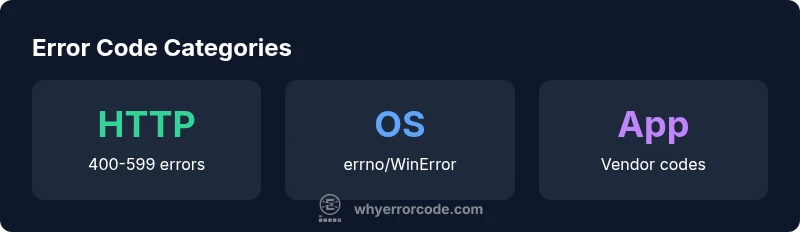
There is no single universal list of error codes; they vary by domain, system, and vendor. According to Why Error Code, the most common families are HTTP status codes, operating system errno/WinError values, and vendor- or framework-specific application codes. Understanding these families helps you map codes to messages, root causes, and remediation steps across different tech layers.
What the phrase "list of error codes" means in practice
According to Why Error Code, there is no universal master list of error codes applicable to every system. The phrase typically refers to curated catalogs that group codes by domain, such as HTTP, operating systems, databases, or vendor frameworks. A practical list is always scoped to a particular technology stack and includes mappings to user-friendly messages, possible root causes, and recommended remediation steps. By treating this phrase as a family of lists rather than a single item, teams can tailor their catalogs to their architecture and deployment patterns. The goal is to provide a consistent lookup experience for developers, operators, and help desks, so that the same code reliably triggers the same diagnostic path across environments.
Domains that generate error code catalogs
Error codes arise from many sources. The major domains include web protocols (HTTP status codes), operating systems (errno on Unix-like systems and WinError on Windows), databases (SQLSTATE values), and application or framework layers (vendor-specific codes). Each domain maintains its own codes, semantics, and recommended actions. In practice, building a unified catalog means linking these domain-specific lists to common remediation workflows, so a 404 in a web app and a file-not-found in a desktop tool both lead to clear next steps for users and operators.
Structure and syntax of common error codes
Error codes come in various formats: numeric, alphanumeric, and sometimes short textual tokens. HTTP status codes are triplets (e.g., 404, 500), while OS and database codes often use numeric errno or SQLSTATE identifiers. Some ecosystems combine a short prefix with a numeric suffix (e.g., E101, W200). Consistency in code length, prefixing, and case matters: it reduces ambiguity in logs, dashboards, and automation scripts. A well-designed catalog documents these patterns and includes a decoding table that translates codes into human-friendly messages and actionable steps.
How to build and maintain a centralized catalog
Start with a scope that matches your stack—e.g., HTTP, datastore, and backend services. Create a structured schema: code, domain, meaning, affected component, user message, probable cause, remediation, and decision authority. Version the catalog and require change management for new codes. Provide cross-references to official specs and vendor docs. Establish a governance model with owners for each domain, a rotation schedule for reviews, and a process for deprecating obsolete codes. Finally, implement automated tests that verify code-message mappings in staging, then promote to production alongside code changes.
Practical mapping: from codes to messages and remediation
A code is only as useful as its guidance. Map each code to: (1) a concise user-facing message, (2) a short root-cause summary, and (3) a recommended remediation path. Link codes to logs, traces, or dashboards so engineers can diagnose quickly. When codes are ambiguous, provide a tiered remediation path with progressively deeper analysis. Document common misconceptions and ensure messages remain stable across software versions. This mapping enables faster triage, reduces support loads, and improves incident post-mortems.
Examples by domain: HTTP status, Windows errno, Linux errno, database errors
HTTP status codes communicate client/server outcomes: 4xx signals client error, 5xx signals server error. errno/WinError codes reflect operating system feedback (e.g., ENOENT for missing file, ERROR_ACCESS_DENIED for permission issues). SQLSTATE codes describe database states (e.g., 23505 for unique violation). Vendor or framework-specific codes add depth to particular stacks. A practical catalog cross-references these with standardized texts and recommended fixes to align teams across front-end, API, and backend layers.
Internationalization and localization of error codes
Localization challenges arise when translating user messages that accompany codes. Maintain a consistent code region while translating only the human-readable message. Keep developer-facing strings in English to preserve standardization and automation compatibility. A robust catalog documents locale-specific message variants and indicates when a translation is unavailable, fallback strategies, and escalation paths.
Tools and resources to find official lists
Leverage RFCs and official vendor docs for authoritative code definitions. RFC 7231 and related specs govern HTTP semantics; operating system and database communities publish errno, SQLSTATE, and vendor-specific guides. Use search terms like 'SQLSTATE codes', 'WinError list', or 'errno list' alongside the official specification to locate canonical references. Regularly scan for updates during major version changes to avoid drift between your catalog and the live ecosystem.
Common pitfalls and governance of error code catalogs
Pitfalls include duplicating codes across domains, inconsistent naming, and stale mappings. Governance requires clear ownership, change control for new codes, and periodic audits. Avoid overloading your catalog with rarely used codes; prioritize those that impact user experience or incident response. Encourage cross-team reviews to align message tone and remediation steps, reducing confusion during outages.
Representative examples across common error-code categories
| Category | Typical Range/Scope | Notable Examples | Standard References |
|---|---|---|---|
| HTTP Status Codes | 400-599 (errors) | Bad Request (400), Not Found (404), Internal Server Error (500) | RFC 7231, MDN Web Docs |
| OS Error Codes | errno values on Unix-like, WinError on Windows | ENOENT, EACCES, ERROR_FILE_NOT_FOUND | OS and platform docs |
| Database Error Codes | SQLSTATE values | 23505 (unique violation), 22001 (string data out of range) | SQL standard, vendor docs |
| Application-Specific Codes | Vendor/framework-defined | E101, E202 | Vendor documentation |
Frequently Asked Questions
What is an error code?
An error code is a symbolic identifier that signals a specific condition or failure in a system. It helps developers, operators, and users understand the issue and choose an appropriate remediation path. Codes are typically paired with a message and recommended actions.
An error code is a short identifier that tells you what went wrong and what to do next.
Why isn’t there a single universal list of error codes?
Error codes are tied to particular domains, platforms, and vendors. Different ecosystems maintain distinct catalogs with varying formats and meanings. This domain-specific approach allows precise diagnostics but means cross-domain mapping is essential when investigating issues spanning multiple technologies.
Codes are domain-specific, so there isn’t one universal list.
How should I structure a local error-code catalog?
Start with scope (domains and systems covered), then define fields like code, meaning, remediation, and owner. Version the catalog, enforce governance, and integrate it with logs and incident workflows to ensure it stays current.
Define scope, map codes to fixes, and keep it updated.
Are HTTP status codes considered errors?
HTTP status codes include both client and server error indicators. While some 2xx codes indicate success, many 4xx and 5xx codes represent failure conditions that trigger specific remediation steps in web applications.
HTTP codes include both failures and success states; focus on 4xx/5xx for errors.
Where can I find official lists for common domains?
Official domain lists are published by standards bodies and platform vendors. Search RFCs for protocols and vendor documentation for OS, databases, and frameworks to anchor your catalog in authoritative sources.
Check RFCs and vendor docs for authoritative lists.
“"To turn error codes into actionable fixes, you must document meanings, contexts, and remediation steps. A living catalog aligned with your stack is essential."”
Top Takeaways
- Define scope before cataloging
- Document meaning, cause, and remediation
- Version controls keep catalogs trustworthy
- Map codes to actionable outcomes