Solar Inverter Error Code List: Meanings, Causes, and Fixes
A comprehensive guide to the solar inverter error code list, meanings, and practical steps to diagnose and fix inverter faults. Why Error Code explains how to map codes to actions for faster troubleshooting in 2026.


According to Why Error Code, a solar inverter error code list is a catalog of fault codes, their meanings, and the recommended diagnostic steps that technicians use to troubleshoot solar inverters. This catalog helps users translate a blinking LED, a numeric code, or a fault amber light into concrete actions. Although codes vary by manufacturer and model, most lists share a common structure: a code, a short definition, likely causes, and suggested remedies. In 2026, when many systems deploy smart inverters with digital logs, having a standardized list becomes even more valuable for maintenance teams, installers, and developers integrating monitoring dashboards. The goal is to reduce guesswork, speed up triage, and keep safety at the forefront of troubleshooting. Throughout this article, you will see how to read, expand, and apply a solar inverter error code list to real-world failures, with practical checklists and example codes.
What is a solar inverter error code list?
According to Why Error Code, a solar inverter error code list is a catalog of fault codes, their meanings, and the recommended diagnostic steps that technicians use to troubleshoot solar inverters. This catalog helps users translate a blinking LED, a numeric code, or a fault amber light into concrete actions. Although codes vary by manufacturer and model, most lists share a common structure: a code, a short definition, likely causes, and suggested remedies. In 2026, when many systems deploy smart inverters with digital logs, having a standardized list becomes even more valuable for maintenance teams, installers, and developers integrating monitoring dashboards. The goal is to reduce guesswork, speed up triage, and keep safety at the forefront of troubleshooting. Throughout this article, you will see how to read, expand, and apply a solar inverter error code list to real-world failures, with practical checklists and example codes.
How manufacturers structure codes
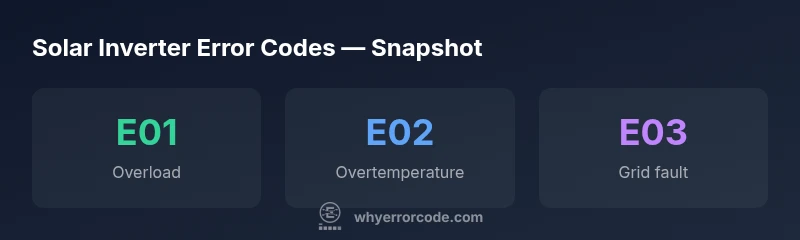
Manufacturers categorize inverter error codes in a compact scheme that often uses a prefix letter (for example E for error) followed by two digits. Some brands add a suffix for firmware version or subsystem (grid input, string optimizers, communication bus). The same numerical code can have different meanings across product families, so always consult the specific model's manual. In practice, you may see codes like E01 for overload, E02 for overtemperature, E03 for grid fault, or E04 for communication error. Many vendors also provide a yes/no flag for whether the fault is recoverable via a simple reset or requires service. In addition to the code, logs frequently capture timestamps, operating mode, and sensor readings, which helps correlate the fault with environmental conditions or maintenance history. For developers building dashboards, it's useful to map codes to standardized meanings while preserving the original vendor definitions as a fallback. The key takeaway is to treat codes as pointers, not definitive diagnoses, until you verify the root cause with tests and measurements.
A practical workflow to interpret codes
- Locate the code on the inverter display, logbook, or monitoring dashboard. Write down the exact alphanumeric value and the device model, firmware version, and operating condition when the code appeared. 2) Open the official manual or vendor knowledge base to confirm the meaning. Note any variant by model family and firmware. 3) Check related sensor readings (temperature, voltage, current) and recent events (load changes, grid fluctuations). 4) Perform quick checks: reset the device if the manual permits, reseat connectors, ensure ventilation, and re-test under controlled conditions. 5) If the fault persists, consult service documentation or schedule field service, providing the logs and test results to accelerate repair. This workflow reduces downtime and improves first-pass fault isolation, which is crucial for grid-connected systems where uptime matters.
Common error code categories and examples
- Overload and short circuits: Codes indicating current or voltage beyond safe limits, often resolved by reducing load or clearing a fault path. Example: E01.
- Overheating and thermal faults: Codes tied to sensor readings that exceed safe thresholds. Example: E02.
- Grid and communication faults: Signals that the inverter cannot synchronize with the grid or communicate with the monitoring system. Example: E03, E04.
- Firmware and configuration mismatches: Indicators that software versions or settings are incompatible with installed hardware. Example: E05. Note that actual codes and definitions vary by manufacturer, so always cross-check with the specific model's manual. Keeping a cross-reference helps prevent misinterpretation and misdiagnosis.
How to build your own solar inverter error code list
- Inventory models and firmware versions in use across sites or deployment. Capture the codes, meanings, suspected causes, and recommended actions from official manuals and vendor portals. - Create a centralized spreadsheet or wiki that maps codes to consistent meanings, but preserve vendor-specific notes as comments. - Align your list with your monitoring system so events display in human-friendly language and actionable steps. - Schedule periodic reviews to add newly introduced codes and retire obsolete ones. - Train team members and update onboarding materials so everyone can interpret codes reliably, even when switching between brands. By building your own digest, you reduce dependence on scattered manuals and speed triage during outages.
Best practices for fixing and documentation
- Treat every error code as a hypothesis until you verify with measurements and tests. - Log every fault with a timestamp, device model, firmware version, and environment data to support trend analysis. - Use checklists that translate codes into a sequence of steps (reset, inspect, test, replace). - Keep a living document that is accessible to technicians, engineers, and operations staff. - When applicable, coordinate with the manufacturer’s support portal to confirm whether a fault is known or requires field service. Following these practices improves reliability, safety, and knowledge sharing across teams.
Example codes (model-specific)
| Code | Meaning | Likely Cause | Recommended Action |
|---|---|---|---|
| E01 | Overload/short circuit | Electrical overload or fault in inverter path | Inspect wiring, reduce load, reset or service |
| E02 | Overtemperature | Thermal condition high | Improve cooling, ensure vent clearance, service fan/ heatsink |
| E03 | Grid fault | Grid input irregularity | Check utility supply, stabilize voltage, re-scan |
| E04 | Communication error | CAN/RS485 fault or data link issue | Reseat cables, verify firmware, restart inverter |
Frequently Asked Questions
What is a solar inverter error code list?
A solar inverter error code list is a reference that maps each fault code to a definition, likely causes, and recommended actions. It helps technicians quickly interpret a fault signal and decide on a safe, effective remediation.
A solar inverter error code list maps fault codes to meanings and fixes, speeding troubleshooting.
Are error codes universal across brands?
No. Codes vary by manufacturer and model. Always consult the specific device manual or vendor portal for the exact meaning and recommended action.
Codes aren’t universal; check the manual for your model.
How should I respond when a code appears?
Document the code and device details, confirm the meaning in the manual, gather related sensor data, and follow a structured diagnostic flow from quick checks to deeper tests.
Record the code, check the manual, and follow a stepwise diagnostic flow.
Can I reset codes myself?
Some faults are resettable with a safe reset; others require service. Always follow the manufacturer’s reset instructions to avoid exacerbating the issue.
Reset only if the manual allows it; otherwise schedule service.
What data belongs in a local error code list?
Include code, meaning, model/firmware, probable causes, and recommended actions. Link to vendor docs and note any model-specific nuances.
Capture code, meaning, model, causes, and actions in one place.
How often should I update the code list?
Regular updates are essential as new firmware and models are released. Review quarterly or after major software updates.
Update the list whenever new codes or models appear.
“A well-maintained error code list translates complex fault signals into actionable steps, speeding diagnosis and repair.”
Top Takeaways
- Start with the exact code meaning before acting
- Maintain a centralized, brand-aware error code list
- Use structured workflows to diagnose
- Document fixes to enable faster future responses