Carrier AC Error Code 03: Urgent Troubleshooting Guide
Learn what Carrier AC error code 03 means, common causes, and proven fixes. An urgent, step-by-step guide for technicians and homeowners. Safety notes included.


Carrier AC error code 03 indicates a communication fault between the thermostat and outdoor unit, often caused by loose wiring, a faulty sensor, or a failing control module. The quickest fixes are to reset the system, verify thermostat connections, and reseat low-voltage wires at both ends. If the issue persists, power down completely and call a qualified technician to avoid damage.
Understanding Carrier AC Error Code 03
Carrier AC error code 03 signals a fault in the communication path between the thermostat and the outdoor unit. The system cannot reliably receive status updates from the other component, which means the cooling cycle may be blocked or commanded incorrectly. Common symptoms include the indoor display flashing E03 or showing a generic fault, the outdoor unit staying idle, or unusual cycling behavior. This is more than a minor nuisance: if left unresolved, it can lead to energy waste, compressor wear, and degraded comfort. The Why Error Code approach emphasizes diagnosing E03 with a focused, repeatable flow: confirm symptoms, inspect wiring and sensors, perform resets, and escalate when necessary. Remember: safety first—do not probe energized circuits; if you smell burning insulation or see melted connectors, shut power at the breaker and seek professional help. Below, we outline typical causes with practical remedies that address the most common scenarios.
Diagnostic Flow: From Symptom to Fix
Symptom: The control panel or mobile app displays E03 while the outdoor condenser remains quiet or short-cycles. This clue points to a communication fault rather than a pure sensor error. Causes are listed in order of likelihood to help you triage quickly:
- high: Loose, corroded, or poorly connected thermostat wiring between the stat and the outdoor control board.
- medium: Faulty outdoor unit communication module or failing control board that cannot negotiate with the thermostat.
- low: Faulty temperature sensor or miscalibrated sensor in the air handler that misreports temperature.
For each cause, apply a corresponding fix and test the system after each step to see if E03 clears.
Quick Fixes You Can Try Now
If you’re facing E03, try these quick, low-risk steps before diving into a full repair:
- Power cycle: switch off the thermostat and the main breaker for 60 seconds, then restore power.
- Thermostat sanity check: confirm mode (cooling), fan setting, and that the thermostat is communicating with the Wi‑Fi/app if used.
- Inspect wiring at both ends: look for loose screws, frayed insulation, or signs of moisture; reseat connectors firmly.
- Check for corrosion: gently clean exposed terminals and apply dielectric grease if appropriate.
- Avoid DIY sensor or board swaps unless you’re trained: faulty sensors or boards require specialized tools and calibration.
- Document observations: note which actions led to any change in the E03 status to guide a technician.
Step-By-Step Fix: Most Common Cause (Loose Wiring)
- Safety check: shut off power to the outdoor unit and indoor air handler at the main disconnect.
- Tip: Use a non-contact voltage tester to confirm zero voltage before touching wires.
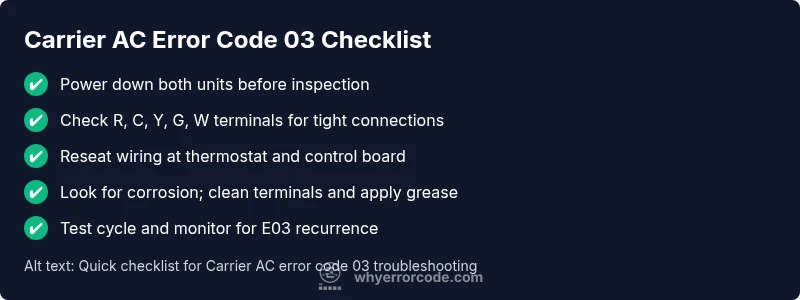
- Inspect thermostat wiring: remove the thermostat cover and check the R, C, Y, G, and W wires; ensure they are tight at both ends.
- Tip: If a wire appears damaged, label it and replace the conductor rather than twisting or taping.
- Reseat connectors: unplug and reseat each wire terminal on the thermostat and the control board; listen for a click to confirm seating.
- Tip: Take a photo before disconnecting to restore the exact wiring order.
- Check for corrosion or moisture: dry the terminal blocks and apply a small amount of terminal grease to prevent future corrosion.
- Tip: Keep connectors dry and avoid introducing moisture during reassembly.
- Reassemble and test: power up the system and run a cooling cycle; observe the thermostat display and outdoor unit status.
- Tip: If E03 persists, proceed to a professional diagnostic rather than continuing to swap parts.
- Confirm resolution: once E03 does not reappear after several cooling cycles, record the successful test and monitor performance over the next 24 hours.
- Tip: Create a simple maintenance log for future troubleshooting.
Other Causes and Their Fixes
- Cause: Defective outdoor unit communication module or control board. Fix: confirmed module replacement or board reflash by a qualified technician; timing and firmware must be matched to the unit model.
- Cause: Faulty temperature sensor or improper calibration in the air handler. Fix: sensor replacement; calibration performed with test runs after install.
- Cause: Power quality issues or a backfeed fault on the line. Fix: verify voltage supply, check for tripped breakers, ensure dedicated circuit per the installation; consider electrical service check if you see frequent surges.
- Cause: Incompatible thermostat app or outdated firmware. Fix: update or revert app version and ensure compatibility with the control board.
- Cause: Damp or flooded control cabinet. Fix: dry the cabinet and ensure proper sealing; avoid moisture in electrical compartments.
Safety Warnings and When to Call a Pro
This error code involves low-level electrical and control systems. If you’re uncomfortable with live wiring, unable to access the service panel safely, or you notice arcing, burning smell, or hot components, stop immediately and contact a licensed HVAC technician. Costs for professional service typically range from $150 to $350 for diagnostic visits, plus potential replacement parts if needed. Expect higher costs if a control board or sensor needs replacement. Always verify that the technician is licensed and insured, and request a written estimate before starting work. For ongoing maintenance, consider a yearly HVAC inspection to prevent future E03 issues.
Prevention and Best Practices
- Schedule regular maintenance: clean sensor housings, inspect wiring harnesses, and test communication between thermostat and outdoor unit.
- Use surge protection on the AC circuit to reduce risk of control board faults due to power dips.
- Update thermostat and firmware in sync with outdoor unit software releases to avoid compatibility issues.
- Keep the indoor and outdoor panels dry and ventilated; ensure proper drainage to avoid moisture-related corrosion.
- Maintain a simple diagnostic log of E03 events to help technicians track recurring issues.
Steps
Estimated time: 60-90 minutes
- 1
Power down safely
Shut off power to both indoor and outdoor units at the main disconnect and, if possible, switch off the electrical panel that feeds the system. Wait 60 seconds to discharge residual energy before inspecting wires.
Tip: Lockout/Tagout if you have access to professional safety equipment. - 2
Verify thermostat settings
Check that the thermostat is set to cooling, and confirm that it’s communicating with the app or panel. If you use a smart thermostat, ensure Wi-Fi connectivity is stable and the device is not in a limited error state.
Tip: Take a screenshot of the current settings before changing anything. - 3
Inspect wiring at both ends
Remove covers and inspect R, C, Y, G, and W terminals. Look for loose screws, discoloration, or frayed insulation. Tighten, clean, or replace as needed.
Tip: Use a multimeter to confirm continuity where you suspect damage. - 4
Reseat and test connections
Disconnect each wire and reattach firmly on both the thermostat and the outdoor control board. Listen for a click and verify that each terminal is snug.
Tip: Keep track of wire positions with a photo before removal. - 5
Perform a controlled reset
Power the system back on and run a cooling cycle. Observe whether E03 persists after several cycles and note any changes in behavior.
Tip: If the fault returns quickly, do not continue swapping parts; proceed to the next diagnostic steps. - 6
Escalate if unresolved
If E03 remains after all wiring checks, arrange a professional diagnostic by a licensed technician to evaluate the control board and sensor integrity.
Tip: Request a written estimate and confirm warranty coverage before parts replacement.
Diagnosis: AC shows error code E03 and outdoor unit is unresponsive
Possible Causes
- highLoose, corroded, or loose terminal wiring between thermostat and outdoor unit
- mediumFaulty outdoor unit communication module or control board
- lowFaulty temperature sensor or miscalibrated sensor in air handler
Fixes
- easyReconnect and secure thermostat wiring at both ends; reseat terminals and replace damaged conductors
- mediumInspect the outdoor unit's communication module and control board; update firmware or replace the module/board as needed
- hardTest and replace faulty temperature sensor; recalibrate if required after installation
Frequently Asked Questions
What does Carrier AC error code 03 mean?
E03 indicates a communication fault between the thermostat and outdoor unit. It’s typically caused by wiring issues, sensor faults, or a failing control module. Follow a structured diagnostic flow to confirm the culprit.
E03 means a communication fault between the thermostat and outdoor unit. Start with wiring checks and a safe reset, then escalate if needed.
Can I fix E03 myself?
Some quick checks, like power cycling and tightening thermostat connections, can be done safely. More complex issues like a faulty control board or sensor should be handled by a licensed HVAC technician.
You can try safe resets and wiring checks, but more advanced repairs should be left to a pro.
Will resetting the system reset the error permanently?
A reset can clear the fault if it was caused by a temporary communication hiccup. If the underlying wiring or component is damaged, E03 will likely return after the reset.
Resetting may clear the fault temporarily, but hardware issues usually come back.
How much does professional repair for E03 typically cost?
Diagnostic visits typically range from $150 to $350, with additional parts costs if a board or sensor is replaced.
Expect a diagnostic fee plus possible part costs if a board or sensor needs replacement.
When should I replace my thermostat versus repair?
If the thermostat is old, repeatedly disconnects, or cannot communicate reliably with the outdoor unit, replacement may be more cost-effective than continuous repairs.
If your thermostat keeps failing to communicate, replacement could be more economical than repairs.
Watch Video
Top Takeaways
- Power cycle to reset may clear E03
- Inspect wiring first; sensors second
- Call a pro if wiring or control board are implicated
- Keep a maintenance log for future faults