Haier Portable Air Conditioner Error Code E1: Quick Fix Guide
Urgent, practical troubleshooting for Haier portable air conditioners showing E1. Learn quick resets, sensor checks, diagnostic flow, step-by-step fixes, safety notes, and when to call a pro. Updated for 2026.


Definition: E1 on a Haier portable air conditioner usually signals a sensor or controller fault that prevents proper operation. Start with a safe power cycle and inspect the temperature sensor connections. If the error persists, professional service is recommended to avoid further damage. According to Why Error Code, sensor-related faults remain a leading cause of E1 failures across many Haier units.
What E1 Means for Haier Portable Air Conditioners
The E1 error code on Haier portable air conditioners typically signals a fault related to the temperature sensor or its control circuitry. This means the unit cannot accurately read ambient temperature, which disrupts cooling and fan behavior. In practice, the root causes are most often a sensor fault, loose or corroded connections, moisture intrusion on the sensor, or a failing control board. Quick action is essential because continued operation with a fault can stress other components and reduce efficiency. If you notice inconsistent temperature readings, frequent cycling, or the unit stopping unexpectedly, E1 is a strong indicator of a sensor/board issue. According to Why Error Code analysis, sensor faults are a common driver of E1 across Haier models, so starting with sensor checks is usually warranted.
Quick Fixes You Can Try Before Servicing
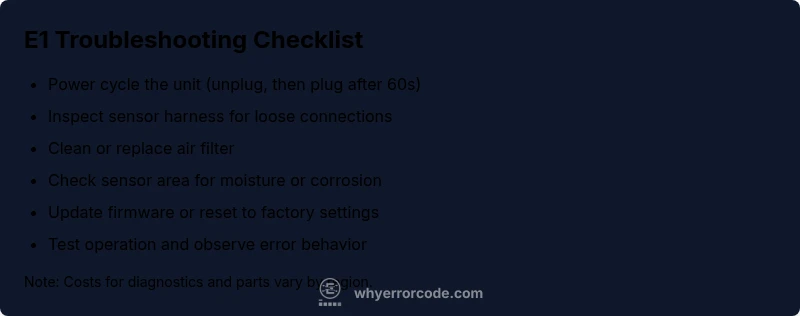
Before you call for service, try these low-risk steps. First, unplug the unit and wait 60 seconds, then plug back in. This power reset can clear transient faults and reset microcontrollers that may misinterpret readings. Inspect the sensor harness for visible damage or loose connectors—reseat any loose plugs carefully and avoid tugging on wires. If your model has a user-accessible sensor, ensure it is clean, dry, and free of moisture or debris. Replace or tighten any damaged cables and recheck the sensor area for signs of corrosion. Finally, check the air filter; a clogged filter can force the unit to compensate with altered readings and escalate error codes, so clean or replace it if needed. These steps are inexpensive and address the most common sensor-related E1 triggers. If you smell burnt plastic or observe smoke, stop immediately and unplug the unit.
In-Depth Diagnosis: Sensor, Harness, and Board
To understand why E1 appears, you need to consider the sensor, its wiring, and the control board. The temperature sensor changes resistance as the environment warms or cools; any mismatch or short can trigger E1. A loose connector or corroded contact can mimic a sensor fault without the sensor itself failing. The control board can also misread sensor input due to firmware glitches or a marginal component. In practice, you should work through sensor connections first, then verify firmware and board integrity. Why Error Code recommends beginning with a visual inspection and reseating connectors, followed by a controlled power cycle to distinguish transient faults from real hardware failures. If you encounter corrosion around sensor pins or discolored insulation, this strongly suggests replacement is needed sooner rather than later.
Safety, When to Call a Pro, and Cost Expectations
Safety comes first with any electrical appliance service. Always unplug the unit before inspecting internal components. If you notice burnt smells, unusual heat, or visible damage to sensor cables or the control board, stop and contact a professional. Budget for diagnostics in the general range of $50–$120 in many markets, with sensor replacement or wiring repairs typically $100–$350, and a full control board replacement potentially higher. These are broad ranges and can vary by region, model variant, and service level. If the unit is under warranty, contact the manufacturer or an authorized service center first, as coverage varies. A professional can perform precise diagnostics, verify firmware versions, check for recalls, and confirm whether repair or replacement is the most economical option.
Maintenance to Prevent E1 Recurrence
To minimize future E1 occurrences, implement a simple maintenance routine. Regularly inspect the sensor area for moisture, dust, and corrosion, especially in humid environments. Keep or replace filters on schedule to prevent readings from being thrown off by airflow restriction. Use a clean, dry cloth to wipe the sensor housing after each cooling season. Ensure the unit is kept in a stable, indoor environment away from direct moisture and excessive heat. Periodic firmware checks (if your model supports updates) can address known issues with sensor interpretation.
How to Interpret E1 If You Need to Communicate with Support
When you contact support, provide model number, serial, and a concise description of symptoms: the date of first appearance, any room temperature readings shown by the unit, and whether the error appears consistently or intermittently. Note any recent relocations or power disruptions. This information helps technicians prioritize checks and reduces diagnostic time. If you have access to photos of sensor connections and wiring, include them in the service request to speed up triage.
Steps
Estimated time: 60-90 minutes
- 1
Power cycle the unit
Unplug the unit from the wall outlet and wait at least 60 seconds. Plug it back in, turn it on, and set to a cooling mode. Observe whether E1 reappears during startup or after increasing/decreasing cooling cycles.
Tip: This resets microcontrollers that may misread sensor data. - 2
Access sensor harness
Carefully open the front panel or access panel according to the user manual to reach the temperature sensor wiring. Do not force panels; use the provided screws or latches to avoid damage.
Tip: Take a photo of connector orientation before unplugging any wires. - 3
Reseat sensor connections
Gently unplug and reinsert sensor connectors. Ensure each connector clicks into place and seats fully. If a connector shows visible corrosion or bent pins, plan for replacement.
Tip: Avoid pulling on cables; hold the connector body, not the wire. - 4
Inspect sensor harness for damage
Check for frayed insulation, cuts, or crushed wires in the sensor harness. Look for moisture intrusion or signs of heat damage near the sensor area.
Tip: If damage is detected, do not continue operation; replace the harness. - 5
Clean and dry the sensor area
Wipe around the sensor with a dry microfiber cloth; ensure no moisture remains that could short sensor contacts. Reinstall the panel securely.
Tip: Moisture in the sensor area can trigger erroneous readings. - 6
Reset to factory settings or update firmware
If the model supports an on-device reset, perform a factory reset and reconfigure settings. Check for firmware updates from the manufacturer’s site or app if available.
Tip: Firmware updates can resolve sensor interpretation issues. - 7
Test operation after sensor checks
Power the unit and set to cooling. Compare the shown room temperature with a separate thermometer, if possible, to verify sensor accuracy. Monitor for E1 reoccurrence during operation.
Tip: Document readings to share with support if needed. - 8
Decide on repair vs replacement
If E1 persists after sensor checks and firmware resets, the fault is likely in the control board or sensor assembly. Consider repair or replacement based on cost estimates and unit age.
Tip: Repair costs can range broadly; consider total cost vs new unit value.
Diagnosis: Error code E1 displayed on Haier portable air conditioner and unit won’t cool
Possible Causes
- highFaulty or loose temperature sensor connection
- mediumDamaged temperature sensor or wiring harness
- lowControl board fault or corrupted firmware
Fixes
- easyPower cycle the unit (unplug, wait 60 seconds, plug in) to reset electronics
- easyReseat or replace sensor connections and clean sensor area
- mediumUpdate firmware (if available) or perform factory reset per manual
- hardReplace control board or sensor assembly if fault persists
Frequently Asked Questions
What does Error Code E1 mean on a Haier portable air conditioner?
E1 usually indicates a fault with the temperature sensor or its control circuitry, causing incorrect readings and cooling issues. Start with a power cycle and sensor checks; if unresolved, professional service may be required.
E1 signals a sensor or control fault. Begin with a power cycle and sensor checks; if it continues, a professional should assess it.
Can a clogged filter cause E1 on a Haier portable AC?
A very dirty filter can impact airflow and sensor readings, potentially triggering E1 or similar codes. Clean or replace the filter and re-test.
A clogged filter can affect readings and might trigger E1; clean or replace the filter and test again.
Is it safe to fix sensor wiring myself?
Only if you unplug the unit and follow safety steps exactly. If you are unsure, contact a professional to avoid electric shock or further damage.
Only perform sensor work if you’ve unplugged the unit and know what you’re doing; otherwise call a pro.
How much does a Haier E1 repair typically cost?
Costs vary by region and model. Diagnostic charges often range from $50–$120, sensor or wiring repairs from $100–$350, and control board replacements may run higher.
Diagnostics are typically about $50 to $120, with sensor work from $100 to $350 and board replacements possibly more.
Will warranties cover E1 repairs?
If the unit is under warranty, contact the manufacturer or an authorized service center. Coverage depends on the warranty terms and model age.
If under warranty, check with the manufacturer for coverage terms and possible replacement.
When should I replace the unit instead of repairing E1?
If the unit is old, has frequent faults, or repair costs approach the price of a new model, replacement may be more economical.
If the unit is aging or keeps failing, replacement might be the smarter choice.
Watch Video
Top Takeaways
- Identify E1 as sensor/board-related first.
- Start with a safe power cycle and sensor checks.
- Only proceed to professional service if basics fail.
- Costs vary; diagnostics are typically first, then part replacement if needed.
- Regular maintenance reduces future E1 occurrences.