Hot Tub Error Code E90: Diagnose and Fix Fast
Understand hot tub error code E90: meanings, common causes, safe quick fixes, and step-by-step diagnostics. Learn when to call a professional and how to prevent E90 from returning.


Hot tub error code e90 signals a safety or sensor fault that blocks operation. In many cases, E90 is triggered by a faulty temperature sensor, a tripped high-limit switch, or a control-board glitch. Start with a quick reset: power down the tub, wait 60 seconds, then power back up; check water level and filters, and call a technician if the code persists.
What E90 Means for Your Hot Tub
Hot tub error code e90 is a safety-centric fault that lights up when the system detects an abnormal condition in the temperature regulation or safety circuits. When E90 appears, the tub typically halts heating and often stops circulation or jets to prevent damage or safety risk. According to Why Error Code, understanding the distinction between a sensor fault, a safety-limit trigger, and a control-board hiccup helps you decide whether a quick reset will suffice or a professional diagnostic is needed. In most modern hot tubs, the sensor network includes the temperature sensor, pressure/flow sensors, and the high-limit switch. Any one of these can trigger E90 if readings are out of spec, if there is wiring damage, or if the control logic detects a fault. Recognize E90 early to minimize potential damage and downtime, and always prioritize safety when handling electrical components around water.
Common Causes of E90 in Hot Tubs
There are several plausible culprits behind hot tub error code e90, with the likelihood varying by model and age of the system. The most common is a faulty temperature sensor or its wiring, which can send incorrect readings and trigger a safety lock. A tripped high-limit switch or a malfunctioning safety circuit can also cause E90 by interrupting heat or circulation. Less frequent but possible causes include a control-board fault, loose connections in the sensor harness, or low water flow due to a clogged filter. If you recently performed maintenance or installed a new part, double-check those connections first. Remember that while sensor issues are common, a deteriorating control board can mimic sensor faults and is typically more expensive to replace.
Quick Fixes to Try Before Servicing
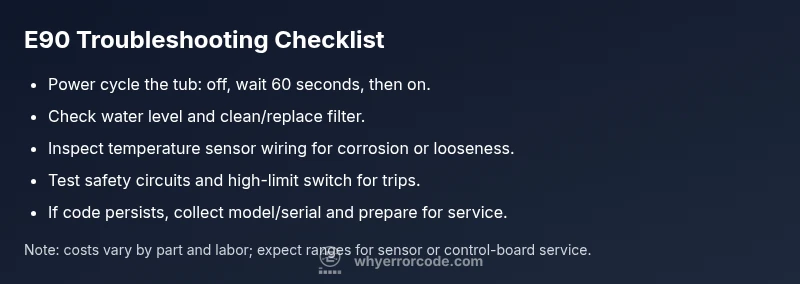
Before pulling the tub apart, try a safe reset and basic checks. Power down the unit completely, wait at least 60 seconds, and restart to see if E90 clears. Confirm water level is adequate and the filter is clean or replaced if dirty. Inspect visible sensor connectors for corrosion or looseness and reseat them firmly. If the code reappears after a reset and checks, document the model, serial number, and any recent changes; this helps a technician diagnose faster. Do not attempt invasive repairs unless you are trained, as improper handling can cause electrical shock or water damage.
Diagnostic Mindset: Narrowing Down the Fault
Think of E90 as a fault flag rather than a single component failure. Start with the lowest-risk checks (reset, water level, filter) and proceed to sensor wiring. A simple resistance test on the temperature sensor (per the manufacturer’s service manual) can reveal a drifting or open circuit. If readings are out of spec or the sensor shows physical damage, plan for a replacement. If sensor integrity is fine, re-evaluate the safety circuits and the control board. A systematic approach—reset, verify, test, replace—reduces time and avoids unnecessary parts purchases.
Other Causes and Fixes
Beyond sensors and safety circuits, several issues can masquerade as E90. Air locks in the plumbing, low water flow, or a partially blocked filter can cause improper readings and fault triggers. Loose or corroded connections in the control panel harness may intermittently create faults that resemble E90. In some brands, software glitches can misreport the error; a firmware update or a factory reset might help, but only if supported by your model. For some older tubs, capacitor wear or aging wiring can degrade performance and trigger alarms. If you suspect any of these, document symptoms and test results and consult official manuals or a trained technician.
Safety, Warnings, and When to Call a Professional
Water and electricity are a dangerous combination. Always cut power at the breaker before inspecting electrical components. Do not immerse yourself in the tub or handle live conductors with wet hands. If you are uncomfortable with testing sensors, wiring, or the control board, contact a licensed technician. Electrical repairs on hot tubs typically involve part replacement and safety checks that should be performed by a pro. Expect costs to vary widely based on the exact component and labor needed; sensor replacements are generally less expensive than control-board overhauls.
Prevention: Maintenance to Avoid E90 in the Future
Regular maintenance helps minimize E90 occurrences. Schedule periodic sensor and wiring inspections, keep the water chemistry balanced to prevent sensor degradation, and clean or replace filters as recommended by the manufacturer. Protect electrical components from moisture exposure by ensuring all access panels and gaskets seal properly. Maintain documentation of your tub’s service history and any error code patterns; that information speeds future diagnostics and can help preserve warranty coverage.
What to Expect When a Pro Arrives
When a professional arrives to diagnose E90, expect a structured assessment: verify power supply, inspect sensor wiring, test the temperature sensor, check the high-limit switch, and review recent maintenance activity. They should provide a transparent estimate with a breakdown of parts and labor within a reasonable range. Overall costs vary by region, tub model, and what parts need replacement, but you can expect a multi-factor estimate rather than a single price. Bring your tub’s model number, serial, and the exact code history to streamline the visit.
Steps
Estimated time: 60-90 minutes
- 1
Power down and reset
Turn off the hot tub at the main breaker. Wait 60 seconds to discharge residual power. Turn the tub back on and monitor for a reoccurrence of E90. If the error clears, use the tub normally but schedule a full diagnostic if it reappears.
Tip: A frequent reset is a temporary measure; do not rely on it as a permanent fix. - 2
Check water level and filter
Ensure the water is at the proper level and that the filter is clean or replaced. Poor water flow can lead to sensor misreads and trigger fault codes. Run the circulating pump briefly to ensure proper flow.
Tip: Clean or replace filters every 1-3 months depending on usage. - 3
Inspect sensor wiring
Locate the temperature sensor and inspect the wiring harness for corrosion or loose connections. Reseat connectors firmly and ensure there is no visible damage to insulation.
Tip: Only handle connectors when the tub is powered off. - 4
Check safety circuits
Inspect the high-limit switch and safety relays for signs of damage or tripping. If you can, test continuity according to the service manual and look for burned or degraded components.
Tip: If you feel unsure, skip this step and proceed to professional service. - 5
Run a diagnostic test
If your model supports onboard diagnostics, run it and capture any additional error codes or logs. Compare findings to the manufacturer guide to identify the likely faulty subsystem.
Tip: Document results with timestamps for reference. - 6
Plan for professional service
If E90 returns after resets and basic checks, contact a technician. Provide the model, serial, and the observed steps you took. Prepare to discuss sensor replacement or control-board repair.
Tip: Ask about part availability and warranty implications.
Diagnosis: Hot tub displays E90 and won’t heat or circulate
Possible Causes
- highFaulty temperature sensor
- highTripped high-limit switch or safety circuit
- lowControl board fault or wiring issue
Fixes
- easyReset the system by powering off, waiting 60 seconds, then power on; observe if the code clears
- easyInspect temperature sensor connections and reseat; test if allowed by manual
- hardReplace faulty sensor or control-board (professional service); expect parts + labor costs
Frequently Asked Questions
What does hot tub error code e90 mean?
E90 indicates a sensor or safety circuit fault that blocks operation. It usually involves the temperature sensor, high-limit switch, or control board. Safety should be your first concern when addressing this code.
E90 means a sensor or safety fault is preventing operation. Safety first when addressing this code.
Can I fix E90 myself?
You can perform safe resets and basic checks, but more complex issues—like sensor replacement or control-board work—should be handled by a professional to avoid risk of shock or further damage.
You can try simple resets, but complex repairs should be done by a pro.
How long does a sensor replacement take?
Most sensor or related component replacements take about 1-3 hours, depending on access and model. Labor time varies; some jobs are quicker, others require panel removal and calibration.
Sensor replacement usually takes 1 to 3 hours depending on the tub.
Is E90 expensive to repair?
Repair costs vary by part and labor. Expect ranges from a low hundreds to potentially over a thousand dollars for a control-board replacement, depending on the brand and whether it’s under warranty.
Costs can vary a lot; parts and labor may range from a few hundred to over a thousand dollars.
Will resetting clear the E90 permanently?
A reset can clear the error temporarily, but if the underlying fault remains, the code is likely to reappear. A persistent E90 usually requires a diagnostic and possible part replacement.
Resetting may clear it temporarily; if the fault persists, professional diagnostics are needed.
Watch Video
Top Takeaways
- Identify E90 as a sensor/safety fault, not just a generic error.
- Start with safe resets and basic checks before engaging trials or replacement parts.
- Sensor or wiring issues are most common; control boards are less frequent but costlier.
- Always prioritize safety and consult a professional for persistent issues.