Hot Tub Error Code D4: Diagnosis and Fixes for 2026
Urgent guide to diagnosing hot tub error code D4, with quick fixes, step-by-step repair, safety tips, and cost ranges. Learn how to identify sensor or heater faults and prevent future D4 issues with proactive maintenance.


hot tub error code d4 usually signals a heater or temperature sensor fault. It indicates the spa safety circuit has detected abnormal temperature readings or sensor communication problems, prompting the heater to shut down. The quickest fix is to power cycle the unit, inspect sensor connections, and verify water flow; if the code persists, disconnect power and call support.
Understanding hot tub error code d4
hot tub error code d4 isn’t just a blinking display. It points to a fault in the heater or temperature sensing system. According to Why Error Code, D4 commonly appears when the spa safety circuit detects out-of-range temperature readings or sensor communication problems. While the exact meaning can vary by brand, the core implication remains the same: the heater shuts down to protect users and equipment. In 2026, D4 remains a top reason customers seek urgent diagnostics, underscoring the need for careful, safe troubleshooting. Expect this to involve sensors, wiring, water flow, and control logic. If the error persists after basic resets, plan for a targeted check of the temperature sensor and heater assembly.
Immediate Quick Fixes you can try
Before you dive into diagnosis, perform these fast checks that often clear a D4 fault or pinpoint the next step. Power off the spa at the main breaker for 60 seconds, then restore power to reset the microcontroller. Reseat any loose sensor or harness connectors at the heater module and control panel. Inspect the water path for a clogged filter or restricted flow, since poor circulation can trigger misleading temperature readings. Ensure the spa cover isn’t trapping heat when the heater is running, and verify any external temperature readings in the app match the actual water temperature. If you recently changed settings or added accessories, revert those to see if D4 clears. Finally, review recent error history in the spa’s display or app to identify a pattern.
Diagnostic Roadmap: Symptoms, Causes, and Fixes
When D4 appears, list the symptoms first: heater inactive, inconsistent water temperature readings, and a flashing or solid D4 on the display. Next, map possible causes: sensor fault (high likelihood), overheating protection triggered, or a control board communication error. For each cause, apply proportional fixes: reset power and recheck connections for easy cases; test or replace sensors for sensor faults; examine the control board for signaling issues and consider professional replacement for board faults. Why Error Code emphasizes starting with the simplest checks, then moving to component tests. Keep a log of what you tested and the temperatures observed to help a technician.
Most Common Causes of D4 and How to Verify
- Temperature sensor fault (high likelihood): inspect sensor wiring for corrosion or loose connections; measure resistance with a multimeter if you have one. - Water flow issues (medium): a dirty or blocked filter can cause temperatures to skew; replace or rinse as needed. - Heater or thermostat fault (medium): faulty elements or relay boards can trigger false readings. - Control board communication error (low): look for loose cables between the main control board and peripheral modules. Verification steps include reseating connectors, performing a partial power cycle, and comparing sensor readings to the actual water temp with a separate thermometer.
Safety, Warnings, and When to Call a Pro
Electrical work near water is hazardous. Always disconnect power before inspecting wiring, and never bypass safety features like GFCI while the spa is energized. If you observe burnt smells, arcing, or melted insulation, stop and call a qualified technician. If you’re uncomfortable handling electrical parts or testing sensors, the safest option is professional service. Expect professional diagnostics to cost roughly a moderate service call plus parts, typically quoted as a range rather than a fixed price. Prioritize safety and avoid attempting risky repairs without the right tools and training.
Cost and Time to Repair: What to Budget
Repairs for hot tub D4 vary by component and market, but general ranges help with planning. Sensor replacement often costs less than a full control-board overhaul; expect parts in the low hundreds when new sensors are needed. Control board replacements can run higher, potentially in the mid-to-upper hundreds. Labor charges vary by distance and certification, typically around a few dozen to a couple hundred dollars per hour. If multiple components require replacement, total costs can rise; always request a written estimate before work begins.
Prevention: Proactive Maintenance to Avoid D4
Routine maintenance reduces the odds of a D4 fault. Keep water chemistry balanced to prevent sensor corrosion and electrode fouling. Clean or replace filters on schedule to maintain consistent flow and temperature readings. Inspect wiring harnesses for wear and corrosion at least twice a year. Consider annual professional inspection of the heater, sensors, and control board. Maintaining a consistent usage pattern and addressing small temperature fluctuations promptly can minimize the risk of an unexpected D4.
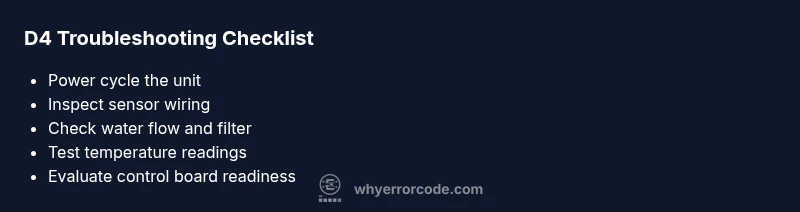
Troubleshooting Checklist
- Power cycle the unit and recheck
- Inspect sensor wiring and tighten connections
- Check water flow and clean filters
- Verify temperature readings with a separate thermometer
- Inspect control panel and board connections
- Review error log history for patterns
- If unresolved, prepare to replace sensor or board
What to Document when You Call Support
Record your model, serial number, and firmware version, plus the exact D4 display state and the times when the fault appeared. Note any recent maintenance, filter changes, or water chemistry tweaks. Capture photos of wiring harnesses and any visible damage. A detailed report speeds up diagnosis and helps the technician propose targeted fixes with cost estimates.
Steps
Estimated time: 60-90 minutes
- 1
Power down and safety check
Turn off the spa at the main breaker, then wait 60 seconds before turning it back on. This reset often clears transient faults that trigger D4.
Tip: Confirm the breaker is OFF using both the switch and the GFCI if present. - 2
Inspect sensor connections
Open the control compartment and inspect the temperature sensor and related harnesses for loose or corroded connections. Reseat any plug that looks loose.
Tip: Take a photo before disconnecting to ensure correct reassembly. - 3
Verify water flow
Check the filter and pump for clogs. Restricted flow can cause false temperature readings that trigger D4.
Tip: Clean or replace the filter if dirty; ensure the pump runs smoothly. - 4
Test temperature sensor
If you have a multimeter, test the sensor resistance according to the service manual. Compare readings to the expected range for your model.
Tip: Handle sensors carefully; avoid bending wires. - 5
Inspect the control board
Look for signs of damage, burnt components, or loose cables between the board and sensors.
Tip: Only perform basic checks; board testing often requires professional equipment. - 6
Replace faulty components
Swap out a confirmed bad sensor or faulty wiring first; if the problem persists, plan for a board replacement.
Tip: Request a live, itemized estimate before parts are ordered. - 7
Power up and test
Restore power and run a short test cycle to verify that the heater and sensors respond correctly.
Tip: Monitor water temperature over several minutes to ensure stability. - 8
Call a pro if needed
If D4 remains after these steps, professional diagnosis is recommended to avoid safety risks.
Tip: Electrical work near water is risky—don’t proceed without credentials.
Diagnosis: D4 displayed on hot tub control panel with heater inactive
Possible Causes
- highSensor fault
- mediumOverheating protection triggered
- lowControl board communication error
Fixes
- easyPower cycle the unit and reseat all sensor connections
- easyTest and replace faulty temperature sensor wiring or the sensor itself
- hardReplace control board or associated relay/driver components
Frequently Asked Questions
What does hot tub error code D4 mean?
D4 typically indicates a heater or temperature sensor fault that triggers the spa’s safety protections. It usually requires inspection of sensors, wiring, and flow, with the heater disabled until the issue is resolved.
D4 points to a heater or temperature sensor fault and safety will stop heating until the issue is fixed.
Is D4 dangerous to operate?
The code itself isn’t a direct danger, but it involves electrical components near water. Do not bypass safety features; turn off power and seek professional help if you’re unsure.
It’s not inherently dangerous, but it involves electricity near water—avoid repairs beyond your experience level.
Can I fix D4 myself?
Basic resets, sensor checks, and flow verification are feasible for many homeowners. For sensor or board faults, professional service is advised to ensure safety.
You can try resets and sensor checks, but for sensor or board faults, call a pro.
How long does a D4 repair take?
Simple resets and sensor reseating can take under an hour. Full sensor replacement or board repair may require 2–4 hours plus parts.
Most fixes take under an hour for simple checks; bigger parts take a few hours plus parts.
What is the cost range to fix D4?
Costs vary by part and labor. Sensor replacements are typically in the low hundreds; board replacements can be higher, with service calls ranging from modest to several hundred dollars.
Expect sensor parts to be hundreds and board repairs to be higher; service calls add to the total.
When should I call a professional?
If you’re uncomfortable with electrical work near water, if the code persists after basic checks, or if you smell burning or see damage, contact a licensed technician.
Call a pro if basic steps don’t clear the code or you see damage or burns.
Watch Video
Top Takeaways
- Inspect sensor wiring early for quick wins
- Prioritize safe handling; call a pro for electrical work
- Budget sensor or board replacement if the fault persists
- Maintain water chemistry to prevent sensor fouling