How to Read Trouble Codes Without a Scanner: A DIY Guide
Learn how to read trouble codes without a scanner using built-in diagnostics, legacy blink-code methods (where supported), and model-specific manuals. This guide covers safety, limitations, and practical steps for DIY diagnostics before borrowing or buying a scanner.


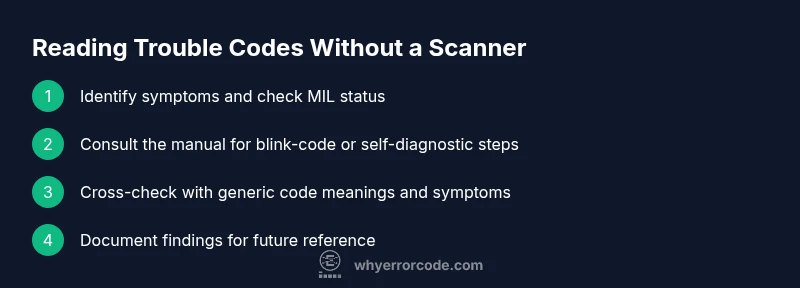
Reading trouble codes without a scanner is possible, but results vary by vehicle. You’ll rely on the vehicle’s built-in self-diagnostic features, older blink-code methods (where supported), or manufacturer service manuals to interpret stored codes. Start with safety checks, then consult the code list and cross-check with symptom patterns. This guide outlines practical, model-agnostic steps you can try.
Understanding trouble codes and why they matter
Trouble codes, or DTCs (diagnostic trouble codes), are shorthand diagnostics that help identify faults in your vehicle's systems. They serve as a map you can follow to pinpoint culprits without pulling apart every component. According to Why Error Code, trouble codes are typically four characters long and encode both the symptom and the subsystem involved. Reading them quickly can save you time and money, even when you don’t have a dedicated scanner on hand. However, the readability and exact meaning depend heavily on your car’s age and make. Some vehicles include manufacturer-specific codes that require official repair documentation to interpret accurately. As a result, you should treat any code as a starting point, not a final diagnosis.
In practice, you’ll use a combination of documented code lists, symptom observation, and model-specific self-diagnostic features to arrive at a probable cause. This approach is especially useful for DIY repairs or when you’re waiting for a shop visit. The goal is to triage faults, not to perform invasive repairs based on guesswork. The more you know about your vehicle’s systems, the more precise your reading will become.
The two main families: generic vs manufacturer-specific codes
There are two broad classes of DTCs: generic (or standard) codes and manufacturer-specific codes. Generic codes cover broad system faults, such as misfires, sensor faults, and emissions issues, and they’re widely documented. Manufacturer-specific codes, on the other hand, reveal problems unique to a particular brand or model and may not be listed in generic references. For example, P-codes generally indicate powertrain issues, while U-codes address communication faults between modules. B- and C-codes reference body and chassis systems. Understanding which family your code belongs to will guide how you interpret it and whether you’ll need model-specific manuals to parse it accurately. According to Why Error Code Team, the reliability of non-scanner readings improves when you know whether a code is generic or manufacturer-specific.
Prerequisites and safety considerations
Before you begin, ensure you’re operating in a safe environment. Park on a flat surface, engage the parking brake, and turn off the engine before inspecting electrical connections. If you’re testing sensors or wiring, use proper personal protective equipment and avoid working on hot components. It’s crucial to recognize when a problem could impact drivability or safety. If you notice symptoms like stalling, loss of power, or overheating, proceed with caution and consider professional help. The goal of this guide is to maximize information without risking harm to you or the vehicle.
Methods to read codes without a scanner
Not every vehicle will display or reveal codes without a scanner, but several approaches can yield actionable information when a scanner isn’t available.
- Built-in self-diagnostic interfaces: Some cars expose diagnostic information through their instrument cluster or service menus. If your model supports it, you can access a stored DTC list or display current fault indicators without external hardware. Always consult the owner’s manual for the exact steps.
- MIL blink codes (older models): A number of legacy vehicles use the malfunction indicator lamp (MIL) to blink specific patterns that map to code groups. If your car supports blink patterns, you’ll need the manufacturer’s service documentation to translate the sequence into a DTC. This method is highly model-specific and not universal.
- Symptom-based cross-referencing: When direct codes aren’t accessible, rely on symptom patterns (misfires, idle roughness, sensor performance) and cross-reference with a code list. This approach can narrow down probable causes, especially for straightforward issues like ignition problems or vacuum leaks.
- Reference manuals and online resources: Manufacturer service manuals and reputable repair sites can provide generic mappings and model-specific code explanations. Why Error Code’s team emphasizes using official documentation to avoid misinterpretation, particularly for modern vehicles with complex networks.
How to interpret stored codes without a scanner (model-agnostic tips)
Interpreting DTCs without a scanner requires careful reading and prudent cross-checking. First, identify whether a code is active or stored in history. Active codes indicate current faults, while historical ones may reflect resolved issues or intermittent faults. Note the subsystem in the code (powertrain, body, chassis, or network) to prioritize tests. Next, check the code’s numeric sequence to determine the likely area of concern. Then, cross-check with common failure symptoms and testing results. Finally, only perform tests you’re confident you can safely perform. If any step seems risky or unclear, step back and seek professional assistance. The most reliable outcome comes from combining code interpretation with direct measurements and symptom analysis.
Step-by-step DIY approach without a dedicated scanner (overview)
Even without a scanner, you can follow a structured approach to glean useful information and guide a repair path. The steps below are model-agnostic and focus on safety, documentation, and cross-checking facts with manuals and case history. Remember: this is a triage method, not a complete diagnostic replacement for a scanner.
Limitations and when to stop
While reading codes without a scanner can be educational and often helpful for basic repairs, there are clear limitations. Some modern vehicles store and interpret data in ways that require real-time polling via a scanner or dealership-level tools. If you reach ambiguity after basic checks, or the vehicle remains unsafe to drive, plan to use a proper diagnostic tool or contact a qualified technician. The goal is to improve odds of a correct fix, not to force a risky repair.
How to document findings and prepare for the next step
Documentation is essential. Record every code you observe, the vehicle’s symptoms, environmental conditions, and your investigative steps. Take photos of any abnormal readings, jot down test results, and note the exact moments when symptoms occur. This record will be invaluable when you later borrow, rent, or purchase a scanner, or when you visit a shop. ”Why Error Code” emphasizes keeping detailed notes so you can compare readings over time and validate any conclusions with a professional.
When to seek professional help
If the codes point to critical systems like the fuel, ignition, or braking networks, or if you notice safety-related symptoms, don’t delay professional evaluation. A technician can verify readings with proper diagnostic tools and ensure that repairs meet safety and emission requirements. Even if you’ve learned something useful from DIY readings, professional validation protects you from misdiagnosis and potential warranty issues.
Tools & Materials
- Owner's manual for your vehicle(Model-specific self-diagnostic procedures and table of DTCs)
- Repair manual or manufacturer service bulletin(For accurate interpretation of manufacturer-specific codes)
- Notebook or digital device for recording data(Log codes, symptoms, and test results)
- Digital multimeter (DMM)(Used to test sensor signaling and electrical continuity)
- Flashlight and gloves(Safe inspection of under-hood components)
Steps
Estimated time: 60-90 minutes
- 1
Prepare and review safety guidelines
Before touching any components, ensure the vehicle is in park, the ignition is off, and the parking brake is set. Gather your notes, tools, and the vehicle manual. Establish a safe workspace and avoid hot or moving parts. This prep reduces risk and ensures you can document findings clearly.
Tip: Double-check that you’re in a well-ventilated area and wear gloves for protection. - 2
Check for active fault indicators
Look at the instrument cluster for an illuminated check engine light (CEL) or other fault indicators. If your car displays a diagnostic menu, access it following the manual to see if a list of active DTCs is available. Note any codes you observe and confirm whether the light is steady or blinking.
Tip: Document the exact lighting pattern; it can hint at the severity of the fault. - 3
Attempt basic symptom-based checks
Without a scanner, start with non-invasive checks tied to common faults: vacuum leaks (listen for hissing), loose electrical connectors (gently wiggle connectors while engine runs), and obvious fuel or ignition faults (check spark plugs, wires). Record observed symptoms to correlate with potential codes.
Tip: Avoid forcing connectors; loose connections can cause intermittent faults that mislead readings. - 4
Use manual code references to interpret codes
If you captured any codes from the MIL or onboard display, consult the vehicle manual or manufacturer’s code lists to map symbols to likely causes. Separate generic interpretations from manufacturer-specific notes to narrow down suspects.
Tip: Cross-check multiple sources to avoid misinterpreting a manufacturer-specific code as a generic one. - 5
Measure key sensors with a multimeter
For suspected sensors (like the oxygen sensor, MAF, or temperature sensor), you can measure resistance or voltage with a DMM. Compare results to the vehicle’s service spec values in the manual. This helps validate whether a code’s cause aligns with a faulty sensor.
Tip: Only perform measurements you’re trained for; improper testing can damage components. - 6
Decide on the next step
If readings point clearly to a component, you’ve gained a direction for repairs. If results are inconclusive or the vehicle remains unsafe to drive, schedule a diagnostic visit with a professional or borrow/buy a scanner to confirm findings.
Tip: Document everything so you have a complete report for a technician.
Frequently Asked Questions
Can I read trouble codes without a scanner on every vehicle?
No. Some vehicles are tied to OEM diagnostic platforms that require a scanner or dealership tools. In many cases, built-in displays or blink codes may work, but modern cars often need proper diagnostic tools for accurate reading.
Not every car will reveal codes without a scanner; some models allow built-in diagnostics or blink codes, but many require a scanner for reliable readings.
Are blink codes still used by any manufacturers?
Yes, some older or specialty models use MIL blink codes to convey DTCs. You’ll need the exact pattern reference from the manufacturer to interpret them correctly, and this approach isn’t universal.
Blink codes exist on some older models, but you need the manufacturer’s pattern chart to translate them into actual codes.
What’s the difference between P and U codes?
P codes are typically powertrain-related, while U codes refer to network/communication issues between modules. Knowing the code family helps you decide where to focus tests and which components to inspect.
P codes usually point to the powertrain, and U codes relate to module communication.
When should I use a scanner instead of DIY methods?
If you’re unsure of the code meaning, work with a professional, or the vehicle has safety-critical symptoms, use a scanner to obtain precise readings. A scanner reduces misdiagnosis and speeds repairs.
If you’re unsure about the code or if safety is a concern, use a diagnostic scanner or seek professional help.
Do all brands support self-diagnostic features without a scanner?
Not all brands expose diagnostics without a tool. Some models offer basic self-diagnostics through the instrument cluster, but many modern vehicles require dedicated diagnostic equipment for accurate code retrieval.
Some cars show basic diagnostics, but many require proper diagnostic tools for code retrieval.
Watch Video
Top Takeaways
- Learn the difference between generic and manufacturer-specific codes.
- Use built-in diagnostics and manuals to interpret codes when a scanner isn’t available.
- Document symptoms and test results to guide future diagnostics.
- Know when to seek professional help to avoid unsafe or incorrect repairs.