How to Fix Toshiba Washing Machine Error Code E2 Fast
Learn how to diagnose and fix Toshiba washing machine error code E2 quickly with Why Error Code. This urgent guide covers common causes, fast fixes, step-by-step repairs, costs, and when to call a pro.


Washing machine Toshiba error code E2 means the drum did not drain properly due to a drainage fault or motor issue, interrupting the cycle. In most cases, the quickest fix is to inspect and clean the drain pump and filter, clear blockages, and reset the washer. If the error reappears, test the drain hose, check for sensor or control-board faults, and consider professional service.
Understanding Toshiba Error Code E2
The Toshiba washing machine error code E2 typically signals a drainage problem that prevents the drum from emptying water as the cycle progresses. While the exact meaning can vary by model, E2 is commonly tied to water not draining within the expected time window. This often points to a blockage or restriction in the drain path, a failed drain pump, or a sensor/control issue that prematurely halts the cycle. For technicians and curious users alike, the most important approach is to verify the drainage pathway first, because most E2 faults are drain-related rather than electrical in nature. By focusing on the drain system, you can rapidly rule out several major causes and avoid unnecessary component replacements. The Why Error Code team emphasizes that documenting symptoms and test results helps track progress and narrow down root causes more efficiently.
Quick Fixes You Can Try Immediately
- Unplug the unit and move it to a safe area if possible. Safety first: water and electricity are a dangerous combination.
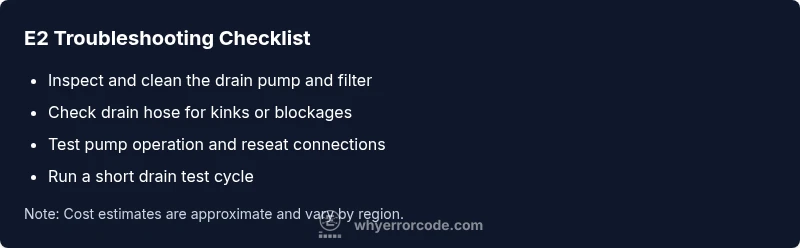
- Check and clean the drain pump and any accessible filters. A clogged filter or pump impeller is a very common reason for E2 to appear.
- Inspect the drain hose for kinks, bends, or blockages. A restricted hose can prevent water from leaving the drum, triggering E2.
- Run a short, empty cycle to see if water drains properly after cleaning and straightening hoses.
- If you have a rear-access panel or service door, inspect for obvious leaks or loose connections around the pump and hoses. Tighten clamps and reseat hoses carefully.
- If the error persists after these steps, you may be facing a sensor or control-board issue that requires professional testing. Remember: avoid replacing multiple parts at random; confirm by testing each component in order of likelihood.
Diagnostic Flow: Symptom to Likely Cause
When E2 appears, start from the symptom and work toward the root cause. A typical flow is: (1) Symptom: cycle stops with E2 and water remains in the drum. (2) Most likely causes: clogged drain pump/filter (high likelihood), blocked drain hose (medium), or a faulty pump sensor/control board (low). (3) Common fixes: clean pump/filter, clear hose, reset the machine, test pump operation, reseat electrical connections, and check for error reoccurrence. If the fault persists after these checks, escalate to more advanced tests of the control board or pressure switch. This diagnostic order prioritizes the most common drain-related faults to minimize downtime and repair costs.
Why Water Might Not Drain: Common Mechanisms
Drainage is a multi-component system. A clog in the filter or pump impeller can stall draining even if the pump motor works. A kinked or blocked drain hose prevents gravity-assisted flow, while air gaps or blocked sensors can misreport water level, causing an automatic stop. In some models, a faulty pressure switch or control board will also falsely detect a full tub and halt drainage. Understanding these mechanisms helps you target the repair without unnecessary part replacements and aligns expectations for cost and effort.
Safety, Warnings, and When to Call a Pro
Many Toshiba models use high-voltage control electronics and water connections that pose risks if mishandled. Always unplug the unit before inspecting internal components. If you notice burning smells, unusual noises, or visible damage, discontinue attempts and contact a licensed technician. For cost expectations, simple fixes like cleaning filters and hoses typically cost mainly in parts (if any) and a service call, while full pump replacement or control-board repairs can range higher. If your appliance is under warranty, consult the manufacturer before opening any service panels to avoid voiding coverage.
Steps
Estimated time: 60-90 minutes
- 1
Power down and safety check
Unplug the washer and switch off the circuit breaker to ensure no power is flowing. Move the unit to a safe, dry area if you need access to the drain/ pump. Have a shallow tray ready to catch residual water.
Tip: Wear gloves and use a flashlight to inspect the area around the pump without forcing hoses. - 2
Access the drain pump and filter
Open the service panel or filter door according to your model manual. Locate the drain pump and filter housing. Remove the filter and wipe out any debris that could impede flow.
Tip: Take photos before disassembly to aid reassembly. - 3
Clean and test the drain components
Rinse the filter under running water and clear the impeller area. Reinstall the filter and run a short diagnostic cycle with no load to observe draining.
Tip: Listen for steady, continuous pump operation without rattling. - 4
Inspect the drain hose
Detach the drain hose and check for kinks, clogs, or crushing. Clean the hose with water and re-secure it, ensuring it runs downhill to the drain.
Tip: Do not crimp or bend the hose at the connection points. - 5
Reset and re-test
Power the machine back on and run a test cycle. If the E2 code returns, document the error and proceed to more advanced tests or professional service.
Tip: Note any new indicators or sensor lights that appear during the test. - 6
Advanced checks (if needed)
If drainage still fails, verify wiring to the pump and check for voltage at the pump terminals. Inspect the pressure switch hose for blockages. Do not replace parts without confirmation.
Tip: Only perform these steps if you have the right tools and guidance. - 7
Decide on next steps
If the fault persists after all checks, plan for professional service to test the control board and overall drainage system. Request a diagnostic visit specific to E2 codes.
Tip: Ask for a written estimate and parts list before any replacement. - 8
Document and monitor
Record the steps you took, the outcomes, and any noises or behavior changes. This information helps a technician diagnose the root cause faster if you need to escalate.
Tip: Keep notes organized and dates clear for reference.
Diagnosis: Error code E2 displayed, tub not draining
Possible Causes
- highClogged or dirty drain pump/filter
- mediumDrain hose kinks or blockages
- lowFaulty drain pump or sensor
- lowControl board fault or wiring issue
Fixes
- easyClean the drain pump and filter, remove any debris
- easyInspect drain hose for kinks and clear blockages
- mediumTest pump operation and reseat connections
- hardReplace pump or repair control board if necessary
Frequently Asked Questions
What does Toshiba error code E2 mean on washing machines?
E2 usually indicates a drainage fault that halts the cycle. Start with the drain path: filter, pump, and hose, then test again to see if the error clears.
E2 signals a drainage fault. Start with checking the drain filter, pump, and hose, then test the cycle again.
Is E2 always caused by a clogged drain?
Not always. E2 often points to drainage issues, but it can also involve a faulty pump or sensor or a control-board fault. Start with the simplest cause first.
E2 often comes from drainage problems, but it could also be pump or sensor faults. Start with simple checks.
Can I fix E2 myself safely?
Yes, you can perform basic drain checks, unplug safely, and clean accessible filters. Do not attempt high-voltage work or component replacements without guidance unless you’re experienced.
You can do basic checks and cleaning, but avoid risky repairs if you're not experienced.
How much does a professional repair cost for E2?
Costs vary by region and fault severity. A service call may range from a modest diagnostic fee to several hundred dollars if pump or control-board replacement is required.
Costs depend on the fault. Expect a diagnostic fee plus parts and labor if replacement is needed.
When should I call a pro for E2?
Call a pro if basic drain checks don’t resolve E2 after a few attempts, or if you notice burning smells, water leaks, or electrical hazards.
Call a pro if basics don’t fix E2 or you detect hazards.
Will E2 recur after a fix?
It can recur if the root cause isn’t fully resolved, such as a failing pump or damaged control board. Re-test and monitor for a few cycles after repair.
E2 can come back if the underlying issue isn’t fixed; re-test after repair.
Watch Video
Top Takeaways
- Identify E2 as a drainage-related fault and verify drains first.
- Prioritize pump/filter cleaning and drain-hose inspection.
- Reset and test after fixes before replacing parts.
- If the issue recurs, consult a professional for control-board testing.
- Document steps and test results to speed up diagnostics.