What Is Bosch Dishwasher Error Code E09? Quick Diagnosis and Fixes
Learn what E09 means on Bosch dishwashers, why it occurs, and proven steps to diagnose and fix the heating-related error safely. Quick fixes, cost ranges, and when to call a pro.


What is bosch dishwasher error code e09? In many Bosch dishwashers, E09 points to a heating issue that prevents the wash from reaching the required temperature, triggering a fault. According to Why Error Code, this can result from a faulty heater element, temperature sensor, or loose wiring. Start with quick resets and checks, then move to component testing if the error persists.
What the E09 Code Means for Bosch Dishwashers
When you see the error code E09 on a Bosch dishwasher, it generally signals a problem with the appliance's ability to heat the wash water to the proper temperature. Temperature is critical for effective cleaning and sanitation, so the control board will halt the cycle and display the fault to prevent dishware from being washed in underheated water. The exact root cause can vary by model and age, but heating-related faults are among the most common. According to Why Error Code, the heating circuit, temperature sensor (thermistor), and related wiring are the most likely culprits. Start your investigation with a clear plan: verify power and water supply, inspect heater connections, and test the sensor readings before replacing parts. Document any patterns like recurrences after a cooling-down period to help determine if the fault is intermittent or persistent.
Quick Fixes You Can Try Before Scheduling Service
Some E09 faults are transient or caused by a loose connection. Start with these fast checks that require no special tools:
- Power cycle: unplug the unit for 60 seconds, then plug back in to reset the control board.
- Check the door latch: a faulty door switch can look like a heating error if the cycle never starts properly.
- Inspect the water supply and inlet valve: ensure the dishwasher is filling correctly; insufficient flow can confuse the heating logic.
- Clean the filter and sump: debris can cause misreads in sensors and protect the heater from proper cycling.
- Inspect visible wiring to the heater and thermistor: look for loose connectors, darkened insulation, or corrosion. If the fault persists after these checks, proceed to diagnostic testing or contact support for a professional evaluation.
Diagnostic Flow: Symptoms, Causes, and Solutions
Symptom: The display shows E09 and the cycle stops early. Possible causes (in order of likelihood):
- high: Heater circuit fault or failed temperature sensor.
- medium: Sensor wiring issue or loose connector to the heater.
- low: Control board firmware glitch or power supply instability. Solutions: verify power and water supply, reseat connectors, test the heater with a multimeter, and consider replacing the faulty component. Always perform safety steps before touching live electronics. If you lack the right tools, this step is best handled by a trained technician.
Step-by-Step Fix: Most Likely Cause – Heater or Thermistor Failure
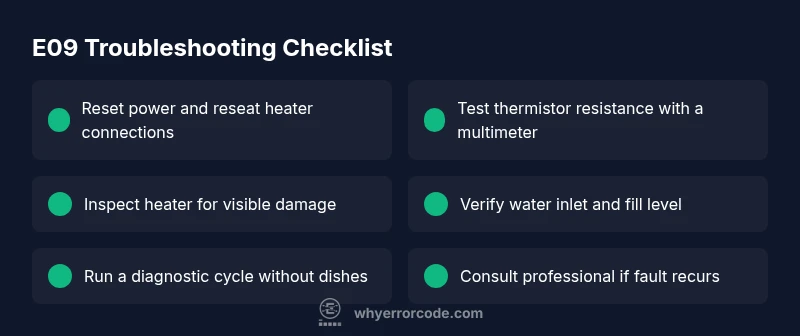
- Power down and unplug the dishwasher to avoid shock.
- Access the heater element and thermistor connectors; unplug and re-seat them firmly.
- Check the thermistor resistance values against Bosch service specs; replace if out of range.
- Inspect the heater coil for signs of burning or grounding faults; if damaged, replace the heater assembly.
- Reconnect all wiring, restore power, and run a diagnostic cycle without loaded dishes.
- If the code returns, plan for professional repair and potential part replacement. Tip: Use a digital multimeter with the dishwasher energized only after you reassemble the access panel.
If the fault persists, a professional service visit is often the most reliable route to a lasting fix.
Other Possible Causes and How to Address Them
If the heater and sensor appear sound, other culprits may be at play:
- Control board fault: a failed microcontroller can misinterpret sensor data; symptoms include intermittent E09 reappearing.
- Wiring harness damage: cracks or crushed wires can break continuity under heat.
- Sensor contamination: mineral buildup on the thermistor can skew readings; cleaning or replacing may help.
- Inlet valve or flow sensor error: low water temperature reading due to flow issues can trigger heating faults indirectly. Addressing these often requires professional inspection or replacement of control boards or harnesses.
Safety, Costs, and When to Call a Professional
Working with high-voltage components inside a dishwasher is hazardous. If you are not confident, stop and call a pro. Quick estimates: heater replacement parts typically range from $40–$150, while labor and service calls may add $100–$250 depending on your region and warranty status. For older units, total repair could exceed the cost of a new unit. Always check your warranty before paying out-of-pocket.
Prevention Tips to Avoid E09 in the Future
Regular maintenance reduces heating faults:
- Clean the filter, spray arms, and sump monthly to prevent sensor misreads.
- Run a periodic cleaning cycle to remove mineral deposits around the heater area.
- Inspect door seals and inlet valves to avoid leaks and underfilling.
- Use the dishwasher according to the manual; avoid overloading which can impair heat distribution.
- Schedule annual service if you rely on the appliance heavily; a technician can calibrate sensors and check the control board.
What to Expect After Fix: Testing, Verification, and Next Steps
After performing the fix, run a full cycle with no dishes and watch the heating process. The temperature should rise to target levels within the normal cycle time. If E09 returns after a few cycles, suspect a failing heater assembly or a sensor fault that requires replacement. Keeping records of service and error codes helps future troubleshooting.
Steps
Estimated time: 75-120 minutes
- 1
Power down and gain safe access
Unplug the dishwasher and wait 60 seconds to discharge capacitors. Remove access panels only after confirming the main power is disconnected. This prevents electric shock while inspecting internal components.
Tip: Label connectors before unplugging to simplify reassembly. - 2
Check heater and thermistor connections
Visually inspect and reseat all heater and thermistor connectors. Loose or corroded contacts can mimic or cause E09 by interrupting the heating circuit.
Tip: Take a photo of the wiring layout before disconnecting anything. - 3
Test thermistor resistance
With the panel still off, remove the thermistor and measure its resistance at room temperature. Compare readings to the Bosch service spec for your model; replace if out of range.
Tip: Use a calibrated multimeter and ensure good ground references. - 4
Inspect heater for damage
Look for burnt insulation, darkened coils, or signs of shorting. Any visible damage means the heater assembly should be replaced rather than repaired.
Tip: Do not attempt to bypass the heater with alternative wiring. - 5
Reconnect and test
Reassemble the access panels, plug in the unit, and run a diagnostic cycle with no dishes to observe heater operation and temperature rise.
Tip: Monitor cycle times; rapid cycling or no heat indicates a component fault. - 6
Plan next steps if E09 recurs
If E09 returns after the test cycle, the fault is likely a failed heater assembly or control board. Schedule professional service and obtain an itemized quote.
Tip: Check warranty status before authorizing parts replacement.
Diagnosis: Dishwasher displays E09 and stops mid-cycle
Possible Causes
- highHeater circuit fault or failed temperature sensor
- mediumSensor wiring issue or loose connector to heater
- lowControl board firmware glitch
Fixes
- easyVerify power and water supply, reseat connectors to heater and thermistor
- mediumTest heater and thermistor resistance with a multimeter; replace out-of-spec parts
- hardReplace heater assembly or control board if faults persist
Frequently Asked Questions
What does E09 mean on a Bosch dishwasher?
E09 typically signals a heating fault, preventing the machine from achieving the proper wash temperature. The exact cause can vary, but heater, sensor, or wiring issues are common culprits. Confirm by testing the heater and thermistor and inspecting related wiring.
E09 usually means a heating fault in Bosch dishwashers. Check the heater and temperature sensor, plus wiring, to confirm.
Can I fix E09 myself?
Some basic checks (reseating connections, resetting the control, cleaning filters) can be done safely. If the heater or thermistor tests out of range, replacement should be handled by a professional.
You can do simple resets and inspections, but heater or sensor replacement is best left to a pro.
How much does it cost to fix E09?
Repair costs vary by model and region. Parts may cost roughly $40–$150, and labor or service calls can range from $100–$250, with total repair often between $140–$400 depending on parts and warranty.
Parts can be around forty to a couple hundred dollars, plus labor; total often falls between roughly a hundred forty and four hundred dollars.
Is E09 dangerous to ignore?
Not typically dangerous, but it involves heating elements and electricity. If you’re unsure, stop using the machine and consult a technician.
It’s not usually dangerous, but treat it as an electrical issue and call a pro if unsure.
Will resetting clear E09 permanently?
A reset can clear a transient fault once, but if the problem recurs, the underlying heater or sensor fault needs proper diagnosis.
A reset might clear it once, but recurring E09 needs a proper check.
Should I replace the dishwasher if E09 returns?
If repair costs approach or exceed a new unit’s price, replacement may be more economical. Compare quotes and consider age, warranty, and energy efficiency.
If repairs are costly or the machine is old, replacement can be more sensible.
Watch Video
Top Takeaways
- Identify heating-related fault first
- Follow safe, incremental tests before replacing parts
- Budget for parts and labor with cost ranges
- Know when to call a pro and check warranty