What Is Error Code 404 on YouTube? Quick Diagnosis and Fixes
Understand what a 404 means on YouTube, common causes, and urgent fixes. This guide helps developers, IT pros, and everyday users troubleshoot quickly and prevent future 404s across devices and networks.


A 404 on YouTube means the requested page or video cannot be found. It usually results from a broken link, a removed video, or restricted access. Quick checks: recheck the URL, refresh, and try another device or network. If the video still isn’t found, the content may no longer be available.
What is error code 404 on YouTube?
When you encounter a 404 on YouTube, you’re seeing the HTTP Not Found response: the server can’t locate the resource you requested. If you search for what is error code 404 on youtube, you’ll often read that this error signals a missing page or video rather than a general outage. According to Why Error Code, 404s on YouTube typically happen because the video was deleted or its URL was changed, not because YouTube’s servers are universally down. The 404 status is a safety net for the browser, indicating the specific resource is no longer available at the address provided. This distinction matters: sometimes the link is broken due to a typo or a bookmarked URL that pointed to an older version of the page. In practice, most 404s are user-level in origin, and you can confirm this by trying the resource on a different device or network. The Why Error Code Team emphasizes that 404s on YouTube are seldom a systemic failure; they are often a symptom of a resource no longer existing or being moved without a redirect. From a troubleshooting perspective, treat 404s as a resource availability issue rather than a service-wide outage, and proceed with targeted checks rather than broad fixes.
##Why You See 404s on YouTube
404s occur when the exact resource cannot be found at the given URL. On YouTube, this can be a video that has been removed, a URL that points to an obsolete location within a channel, a private video with restricted access, or content that has been region-locked so it isn’t served in your area. It can also pop up if the creator changes the video’s privacy settings or if YouTube performs maintenance that temporarily makes a resource unavailable. Because 404s are inherently about missing resources, the most reliable remedy is to verify the resource’s existence via the creator’s channel, official announcements, or a direct search for the video title.
##Are You Looking at a True 404 or a Different Error?
Sometimes you’ll see a 404-like page when the video is temporarily unavailable while the backend routes the request. Other times, YouTube may return a 403 (Forbidden) or 410 (Gone) instead, which have different implications. A 403 usually means your access is blocked (age gate, geo-restriction, or account permissions), while a 410 indicates the resource has been intentionally removed and is not coming back. The distinction matters for how you proceed: a 403 may resolve by adjusting permissions or login state, while a 410 requires finding an alternative video or updated link. In either case, treat it as a resource-status issue rather than a general connectivity problem.
##Contextualizing 404s for developers and IT pros
For teams debugging apps or websites that embed YouTube content, a 404 on YouTube often reflects an upstream resource lifecycle: a video is deleted, renamed, or moved without a redirect. If you control the embedding page or app, implement graceful fallbacks (such as showing a custom message, suggesting related videos, or verifying the video ID before streaming). Always log the failing URL, user agent, and geography to distinguish user-specific issues from global outages. Why Error Code analysis shows that many 404s on YouTube are tied to content lifecycle changes rather than network problems, so a content audit on your end can save hours of wasted troubleshooting.
##Practical consumer-focused checks you can perform now
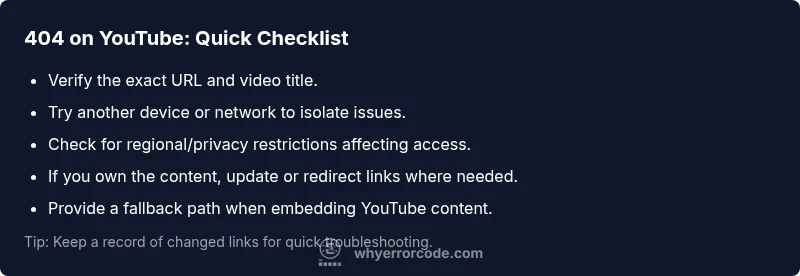
- Re-enter the URL carefully to exclude typos and trailing parameters.
- Try the link on a different device and network to rule out device- or network-specific blocks.
- Search YouTube for the video title or creator channel to see if the video exists under a different URL.
- Clear browser cache or app data, then reload the page to rule out stale redirects.
- Check if you’re signed in with a restricted account or if age or region settings could be blocking access.
- If you’re troubleshooting a brand or enterprise app, implement fallback content or a search suggestion block when a 404 is detected.
##Putting it together: what to focus on when you see a 404 on YouTube
The core takeaway is resource availability. A 404 means the exact resource cannot be found at the requested address. Prioritize validating the resource’s existence with the content owner, confirming regional restrictions, and implementing graceful fallbacks if you’re delivering YouTube content within an app or site. If the content should exist but doesn’t, the fix usually involves updating the link or reconnecting to the new resource.
##How to avoid repeat 404s in the future
- Maintain up-to-date links in your documentation and bookmarks.
- Add redirects when you remove or relocate videos you own or manage.
- Use YouTube’s official channel pages or creator announcements to verify when videos are retired or renamed.
- Monitor for 404s in your apps and alert content managers to verify broken links promptly.
- Consider caching policies that gracefully handle missing content without causing user frustration.
Steps
Estimated time: 15-25 minutes
- 1
Confirm the resource exists
Start by validating the URL you’re using. Copy the link exactly, paste it in a new tab, and press Enter. If the resource is still available publicly, YouTube should load it or display a consistent result. If it doesn’t, proceed to the next checks.
Tip: Cross-check the video title on the creator’s official channel page. - 2
Test across devices and networks
Open the same URL on a different device (phone, tablet, PC) and switch networks (Wi‑Fi, mobile data). This helps identify whether a local cache, ISP, or device configuration is causing the 404. If the video loads on another device, your primary device or network is likely the culprit.
Tip: Disable VPNs or corporate proxies temporarily to see if they’re affecting access. - 3
Clear caches and refresh
Clear your browser cache or app data, then reload the page. An outdated cache can hold a stale redirect or an old page location that results in a 404. After clearing, reload the resource and observe whether the result changes.
Tip: For mobile apps, sign out and back in to refresh session data. - 4
Check for regional or account restrictions
If you’re signed in, verify that your account region, age settings, or channel permissions don’t block access to the video. Try accessing from incognito mode to bypass some session-restricted states. If restrictions exist, you may need to switch accounts or use a permissible location.
Tip: Log out and access via a guest or alternate account to isolate the issue. - 5
Inspect the link lifecycle and redirects
If you own the content, review your video’s publish status and URL path. Ensure there isn’t a trailing slash or query string that breaks the link. If you migrated content, implement a redirect to the new URL and test it across devices.
Tip: Maintain a simple, canonical link structure and document URL changes for teams. - 6
Escalate when content should exist
If you believe the resource should be available (e.g., it’s your own video or a partner’s), contact the content owner or YouTube support with your findings, including the failing URL, timestamp, device, and network context. Provide a path to reproduce the issue.
Tip: Prepare evidence: screenshots, timestamp, and exact URL to speed up triage.
Diagnosis: User sees a 404 error when trying to access a YouTube video or page
Possible Causes
- highVideo has been removed or is no longer available to the public
- highURL is outdated or contains typos
- mediumAccess restrictions (private video, age gate, geo-block)
- lowChannel or video changed location without a redirect
Fixes
- easyVerify the video still exists by visiting the creator's channel and performing a search for the title
- easyDouble-check the URL for typos or extra parameters and reload
- easyAttempt to access via a different device or network to rule out local blocks
- mediumCheck for region restrictions or age gates and sign in with an appropriate account if needed
- hardIf you control the link, update or redirect to the current video URL or provide an alternative
Frequently Asked Questions
What does a 404 error mean on YouTube?
A 404 means the requested YouTube resource cannot be found at the specified URL. It often occurs when a video is deleted, moved without a redirect, or when the link is incorrect. Double-check the URL and try the resource from the creator’s channel or a fresh search.
A 404 on YouTube means the page or video can’t be found at that link. Check the URL, search for the video title, or visit the creator’s channel to locate the resource.
Why would a YouTube video show 404 even if it exists?
If a video exists but shows 404, it might be temporarily unavailable due to regional restrictions, privacy settings, or a redirected URL. Try the video title search, switch accounts, or check for regional limitations.
If a video exists but shows 404, try searching for the title or checking region and privacy settings.
Is a 404 different from a video unavailable message on YouTube?
Yes. A 404 indicates the resource doesn’t exist at the address, while a video unavailable message usually means the video exists but is restricted or blocked for you. The remedy varies: fix the link vs adjust permissions or location.
404 means the resource isn’t found; unavailable means the video exists but is blocked for you.
How long does a YouTube 404 last?
There’s no fixed duration; some 404s resolve quickly if a video is restored or a redirect is added, while others persist until a content owner updates the link. Monitor and test periodically if you rely on the resource.
There’s no set time for a 404 to go away; it depends on content status and redirects.
Can a 404 be caused by my device or network?
Rarely. A 404 is primarily server-side or resource-specific. However, corrupted caches or strict network filters can mimic 404 symptoms. Clear caches, try a different network, and compare results.
Usually not your device, but caches can make it seem that way. Try another network to check.
When should I contact support about a YouTube 404?
If you own the content or depend on a link that should work, contact YouTube support or the content owner with precise failing URLs and testing steps. Provide context from different devices and networks to speed resolution.
If you own the content or the link should work, reach out with details and test results.
Watch Video
Top Takeaways
- Identify whether the resource is truly missing or just relocated
- Verify the URL and test across devices to isolate issues
- Use URL redirects and channel checks to prevent future 404s
- Escalate to content owners or YouTube support when needed