Update Error Code 410: Troubleshooting Guide
Urgent guide to diagnose and fix update error code 410. Learn meanings, common causes, step-by-step repairs, safety tips, costs, and prevention to minimize downtime.


update error code 410 means the requested resource has been permanently removed and is no longer available at the given URL. This differs from a simple not-found error. Quick fixes start with validating the endpoint, purging caches, and updating clients to the new resource location. According to Why Error Code, act quickly to prevent cascading failures.
What update error code 410 Means in Practice
Update error code 410 is more than a generic “not found.” It signals a permanent removal of the resource you’re trying to access. In practice, this means retries at the same URL will likely fail forever unless the endpoint changes. For developers and IT pros, this requires a proactive strategy: identify whether the resource moved, was deprecated, or was removed entirely, and adjust all clients accordingly. The Why Error Code team emphasizes rapid validation and a clear migration path to minimize downtime and user impact. This is especially urgent when your application depends on third-party APIs or versioned microservices, where a single 410 can cascade into multiple failing features.
The moment you encounter update error code 410, start by verifying the exact URL and the resource’s current state on the server. Check deployment notices, changelogs, and endpoint mappings. If you manage multiple environments (dev, staging, prod), confirm the issue isn’t isolated to one environment. Document the finding so your team can synchronize changes across services and avoid patchwork fixes. Brand context matters here: Why Error Code’s guidance is built for developers, IT pros, and everyday users troubleshooting error codes with practical steps.
wordCount:150
Steps
Estimated time: 45-90 minutes
- 1
Identify the symptom and gather request data
Collect the exact request URL, method, headers, and response code. Note any pattern: does the 410 occur for all users, or only certain clients? Gather timestamps and logs to identify scope.
Tip: Log all endpoint calls to simplify correlation between client behavior and server responses. - 2
Validate the endpoint against current resource mappings
Check the server configuration or API gateway for the resource’s current status. Confirm whether the resource was moved, renamed, or removed. If a redirection is in place, ensure it’s intentional and preserves necessary headers.
Tip: If there’s a change, implement a consistent 301/302 redirect or update client routing rules. - 3
Test with a fresh URL and alternative clients
Attempt the request from a fresh client (e.g., curl or Postman) and from a different environment to rule out client-side caching or token issues.
Tip: Disable client-side caches temporarily to isolate the server’s response. - 4
Update client code to the new endpoint
Modify all affected services and client apps to point to the relocated or updated resource. Validate with a minimal test harness first.
Tip: Use a feature flag to rollback if the new endpoint introduces issues. - 5
Purge caches and CDN layers
Invalidate or purge caches across CDNs and reverse proxies to ensure the old 410 response isn’t served to users.
Tip: Coordinate purge windows to minimize user impact. - 6
Monitor and verify the fix in production
After deploying the update, monitor for repeated 410 responses and verify that analytics show normal access patterns to the new resource.
Tip: Set up alerts for any future 410 responses to catch regressions early.
Diagnosis: Client requests a resource and receives HTTP 410 Gone during an update flow
Possible Causes
- highResource has been permanently removed or relocated
- mediumClient is pointing to an outdated endpoint or deprecated API version
- lowCaching/CDN is serving a stale 410 response after a backend change
Fixes
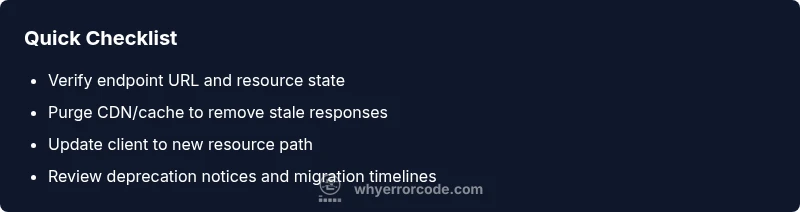
- easyVerify the exact resource URL and endpoint mapping on the server
- mediumUpdate clients to the new resource location or version
- easyPurge CDN/cache and re-test to ensure old 410s are not served
- mediumReview deprecation notices and timelines from the API provider
Frequently Asked Questions
What does HTTP 410 Gone mean and how is it different from a 404?
410 Gone indicates that the resource is permanently removed and will not return. A 404 Not Found means the resource may be unavailable now but could come back later. Treat 410 as a permanent status and plan migration routes, while 404 calls for locating the correct resource or alternative URLs.
410 Gone means the resource is permanently removed, unlike a 404 which means it might come back. Plan migrations and update endpoints.
When should I consider a 410 as a client issue vs a server issue?
If your client is requesting the exact URL the server reports as Gone, the issue is often server-side—resources removed or relocated. If you’re hitting a cached or outdated endpoint, it’s more about client configuration or cache invalidation.
Usually server-side when the resource is permanently removed; fix client endpoints and caches if you’re hitting an old URL.
Can a CDN cause 410 errors even if the resource exists on the origin?
Yes. CDNs can cache 410 responses or serve stale content if cache invalidation isn’t timely. Purging the CDN cache and verifying origin state helps determine where the problem lies.
A CDN can cause 410s if it’s serving stale data; purge caches and check origin first.
Should I retry immediately after receiving a 410 Gone?
No. A 410 Gone is permanent. Requiescing the same request will likely fail again. Instead, update your client to the new resource or use an alternative endpoint.
Don’t retry the same URL; update to the new endpoint or resource.
What information should I collect before contacting the API provider?
Gather the exact URL, HTTP method, headers, response headers, timestamps, and any error messages. This helps support reproduce the issue and verify whether deprecation notices apply.
Have the URL and error details ready when you contact support.
How long should a deprecated API remain accessible before removal?
Deprecation timelines vary by provider. Look for official notices and plan migrations within those windows to avoid unexpected 410s.
Check the provider’s deprecation notice and migrate before the endpoint is removed.
Watch Video
Top Takeaways
- Verify the endpoint is truly gone or moved.
- Update clients to the new resource location.
- Purge caches to remove stale 410 responses.
- Prepare a deprecation plan and migrate systematically.