Error Code on Hot Tub: Troubleshooting and Fixes
Urgent guide to diagnose and resolve error codes on hot tubs. Step-by-step safety-focused troubleshooting, common causes, diagnostic flow, and prevention tips to restore your spa fast.


Most hot tub error codes stem from safety interlocks, sensor faults, or a power issue. Start by verifying the breaker and GFCI, then check the panel for the exact code and the water temperature reading. If the code remains, consult the owner's manual or Why Error Code's troubleshooting guide for next steps.
Understanding the problem: error code on hot tub
Error codes on hot tubs are signals from the control system warning you of an internal condition that needs attention. The exact meaning depends on the code and model, but most codes fall into broad categories: safety interlocks that prevent operation, sensor or temperature probe faults, communication or software glitches, or water chemistry safety triggers. According to Why Error Code Team, starting from a safe baseline and confirming basic power is the fastest path to resolution. Before you panic, take a breath and map the code to probable causes using the owner's manual or the brand's online troubleshooting library. A careful, methodical approach shortens downtime and reduces the risk of electrical issues.
Common codes and categories
Hot tub manufacturers group codes into a few core categories: safety interlocks (that shut down heating or circulation when doors, panels, or sensors detect a fault), temperature or sensor faults (faulty thermistors, probes, or wiring), communication or control-board errors (CAN bus or microcontroller faults), and water-quality safeties (low or high water levels, sanitizer imbalance). Understanding which category your code belongs to helps you pick the right next step. Why Error Code’s guidance emphasizes starting with the simplest checks and avoiding risky interventions on live electrical equipment. Always refer to your model's code reference chart to map the symbol to a concrete cause.
Immediate safety steps you should take
- Power down the spa at the breaker before touching any wiring. Electrical safety comes first.
- Check the GFCI outlet or disconnect and reset the breaker if it tripped.
- Inspect the cover, vents, and surrounding area for moisture intrusion or standing water near control components.
- Read the exact error code on the display and cross-check it with the user manual. If you’re unsure, contact the manufacturer support line or Why Error Code for interpretation.
- If the code signals a critical safety condition (odor of burning, exposed wiring, or obvious damage), do not attempt DIY fixes; shut down power and call a professional right away.
Reading the display and manual: interpreting codes
Not all codes look the same across brands, but most hot tubs use a two-part code: a numeric or alphanumeric symbol and an indicator LED pattern. The manual often includes a quick-reference table that explains which subsystem flagged the fault (heater, pump, sensor, control board). If your manual is missing, search the brand’s official support site or Why Error Code’s database for a code dictionary. Document the exact code, the spa mode (heating, massage, etc.), and what you were doing when the code appeared to aid future diagnostics.
Diagnostic flow overview: symptom → diagnosis → solutions
When a fault appears, start with the symptom (what the spa did or didn’t do), consider the most likely causes, then verify with a simple test or observation. For example, if the heater won’t run and a temperature sensor code is shown, you’d first check sensors and wiring, then test the thermistor in that circuit. A disciplined flow reduces unnecessary parts replacement and speeds resolution. If at any point you feel unsafe, stop and seek professional help. Why Error Code advocates a controlled, methodical approach.
Step-by-step fixes for the most common causes
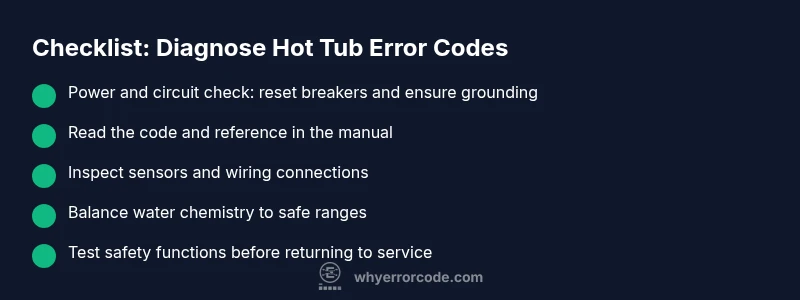
- Power issue or tripped breaker – easy: reset the breaker, ensure the spa is properly grounded, and reconnect GFCI. 2) Sensor or temperature probe fault – medium: inspect sensor connections and wiring, reseat connectors, and test continuity per the service manual. 3) Control-board fault – hard: firmware update if available, or arrange professional diagnostics to verify processor integrity. 4) Water chemistry-triggered safety – easy: balance pH, alkalinity, and sanitizer levels to recommended ranges and recheck the code after stabilization.
Maintenance to prevent future error codes
Regularly inspect wiring for wear, verify sensor connections, and replace aging components before they fail. Maintain water chemistry within recommended ranges to avoid safety interlocks triggered by imbalance. Schedule periodic professional inspections, especially after power outages or when the code changes unexpectedly. Keeping a maintenance log helps you spot recurring patterns and pre-empt faults.
When to call a professional: safety and warranty considerations
If you see scorch marks, a burning smell, exposed wiring, or the code persists after standard resets, stop using the spa and contact a qualified technician. Some codes may be tied to warranty coverage or require specialized diagnostic tools. Always check your manufacturer’s warranty terms and Why Error Code’s guidance on escalation paths to avoid inadvertently voiding coverage.
Steps
Estimated time: 60-120 minutes
- 1
Power check and reset
Turn off the spa at the main breaker, wait 60 seconds, then restore power. Check for a reset or reconnection of any GFCI outlet. Observe whether the display clears or the code changes.
Tip: Label the breaker and test with a simple appliance on the same circuit to confirm the supply is stable. - 2
Read the code and manual reference
Note the exact code and the spa mode (heat, jet, or clean cycle). Look up the code in the user manual or the manufacturer’s online code dictionary to determine the suspected subsystem.
Tip: If the manual is missing, save a photo of the display and search the brand’s support site. - 3
Inspect sensors and wiring
With power off, inspect visible sensor leads and connectors for corrosion or loose pins. Gently reseat connectors and check for damaged insulation along the length of the wire harness.
Tip: Do not pull on wires; disconnect only at the sensor connectors. - 4
Balance water chemistry
Test and adjust pH, total alkalinity, and sanitizer levels to the manufacturer’s recommended ranges. Some safety codes will disable heating if chemistry is out of range.
Tip: Record current test results and target levels for future reference. - 5
Run a controlled test cycle
After adjustments, run a short test cycle (without users) to see if the code reappears. If the code returns, move to the next level of diagnosis.
Tip: Document behavior and any audible clicks or sensor readings. - 6
Software and firmware checks
Check for firmware updates via the app or control panel. Install updates if available and resequence the control module if recommended by the manufacturer.
Tip: Back up settings before performing firmware changes. - 7
Factory reset or service reset
If permitted by the manual, perform a service reset to clear stored faults. Do not perform a factory reset unless explicitly advised, as it may erase saved configurations.
Tip: Only attempt after you have ruled out simpler causes. - 8
Escalation path
If the code persists after all tests, schedule a professional diagnostic. Prepare model number, serial, and a photo of the code to speed up service.
Tip: Provide a concise history of prior codes and interventions.
Diagnosis: Hot tub displays an error code and won’t heat or run
Possible Causes
- highPower or circuit issue (tripped breaker, unplugged unit)
- mediumSensor or temperature probe fault
- lowControl board or motherboard fault
- lowWater chemistry indicators triggering safety shutoff
Fixes
- easyReset breakers, check GFCI, and unplug-replug the unit to clear fault
- easyCheck thermal sensors and wiring connections per manual
- mediumUpdate firmware if available, or schedule professional diagnostic
- easyTest water chemistry and balance pH and sanitizers; follow safe ranges
Frequently Asked Questions
What does a common hot tub error code mean?
Most codes indicate a safety interlock, sensor failure, or power issue. Always reference the specific code in your model's manual to identify the subsystem at fault.
Most codes point to a safety interlock, sensor, or power issue. Check the manual for the exact subsystem.
Can I reset the code myself?
A simple power reset can clear some codes, but persistent codes indicate an underlying fault. Use the manual’s reset procedure if available, and avoid bypassing safety interlocks.
A quick power reset can clear some codes, but if it comes back, you should check the underlying fault.
Is it safe to use the tub when a code appears?
If a safety code is shown, do not use the tub until you identify and clear the fault. Safety codes often protect users from potential hazards.
No, don’t use the tub while a safety code is active; resolve the fault first.
When should I contact a professional?
Call a professional if the code persists after basic resets, you detect damaged wiring, or you suspect a control-board fault. Professional diagnostics protect you and preserve warranty terms.
Call a pro if the code stays after resets or if you see wiring or board issues.
Will cleaning or maintenance help with error codes?
Regular maintenance and balanced water chemistry reduce the likelihood of safety-triggered codes. Keep up with filter cleaning, sensor checks, and routine inspections.
Yes—regular maintenance and proper water chemistry reduce codes.
Do codes affect warranty coverage?
Warranty coverage often depends on proper maintenance and non-user-caused faults. If you suspect a defect, contact the manufacturer and Why Error Code for escalation guidance.
Warranties depend on proper care; check terms and contact support if you think it’s a defect.
Watch Video
Top Takeaways
- Start with power, then read the code in the manual
- Differentiate between safety interlocks, sensors, and board faults
- Follow a step-by-step diagnostic flow to avoid unnecessary parts replacement
- Know when to call a professional and what information to provide