GeForce error code 0x0003: Urgent Fix Guide
Urgent guide for GeForce error code 0x0003: learn what it means, quick fixes, a diagnostic flow, and step-by-step repairs to get your GPU back to peak performance.


GeForce error code 0x0003 typically signals a graphics driver initialization failure or a conflict in software overlays. Immediate actions include updating the NVIDIA driver with a clean reinstall, resetting GPU overclock settings, and disabling overlays like GeForce Experience. If the problem persists, boot to a clean environment and test with minimal software to isolate the cause. Why Error Code recommends a structured, software-first approach before considering hardware repairs.
Understanding GeForce error code 0x0003
GeForce error code 0x0003 is a graphics subsystem initialization issue that shows up when the NVIDIA driver cannot start the GPU pipeline reliably. In practice, you might see this error while launching a demanding game, rendering a scene, or opening a GPU-accelerated application. According to Why Error Code, this error most often points to driver initialization problems or conflicts with software overlays. The fix lies in software hygiene: drivers, overlays, and background services should be pristine and properly aligned with Windows. Treat 0x0003 as a software problem first; if a software reset does not resolve it, you can then escalate to hardware checks. A methodical diagnostic approach is your best ally, and the Why Error Code Team emphasizes documenting each change to avoid circular fixes.
Common causes at a glance
Several factors can trigger GeForce error code 0x0003. The most common include outdated or corrupted GPU drivers, a misconfigured overclock, and overlays from applications like GeForce Experience or third-party tools that conflict with the driver. Power management settings, BIOS/UEFI options related to PCIe, and even Windows updates can contribute to initialization failures. Less frequent but possible causes are hardware faults in the GPU or VRAM, loose power cables, and insufficient PSU capacity. Understanding these causes helps you prioritize fixes, starting from software adjustments to hardware verification if necessary.
Quick fixes you can try now
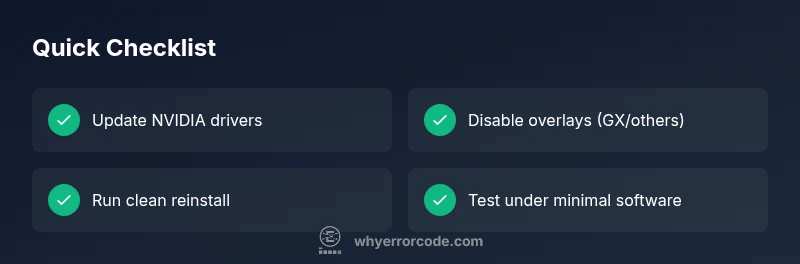
Before diving into deep troubleshooting, try these fast steps. First, update your NVIDIA driver to the latest version and perform a clean reinstall to replace corrupted files. Second, reset any GPU overclock to default values, and disable overlays (GeForce Experience, MSI Afterburner, etc.) to remove software conflicts. Third, ensure Windows is current and that you don’t have conflicting startup programs. Fourth, run a system restart with minimal background apps to confirm the error isn’t caused by a stray utility. If 0x0003 persists, proceed with a more thorough software and, if needed, hardware check.
In-depth driver and software interference
Driver initialization failures often come from remnants of old drivers, partial installs, or conflicting software stacks. A clean reinstall removes traces of prior configurations that could cause 0x0003 to reappear. Use the Display Driver Uninstaller (DDU) in safe mode to remove NVIDIA components, then reinstall the latest driver from NVIDIA’s site. Also review overlay-related software; disabling or uninstalling overlays reduces the risk of runtime conflicts during GPU initialization. Some users report success after temporarily disabling antivirus real-time protection during installation to prevent interference with driver files.
Diagnostic flow in practice (symptom-to-solution)
When 0x0003 occurs, begin with software checks: confirm the driver version, verify Windows updates, and inspect overlay utilities. If software looks clean, test the GPU in another system or with a bootable environment to separate software from hardware issues. Review power delivery and PCIe connections as you progress. If the error remains after software fixes, the next escalation involves hardware verification, power supply checks, and potential GPU replacement considerations. Keep a log of each change for reference and to guide any professional assistance.
Step-by-step plan to isolate causes (software-heavy)
- Create a clean boot environment: disable startup apps and run a minimal session. 2) Uninstall current NVIDIA drivers and reinstall the latest version with a clean install option. 3) Reset GPU overclock settings to defaults and disable all overlays. 4) Verify Windows integrity with a system file check and a fresh user profile test. 5) Run GPU tests in safe mode or a bootable Linux environment to confirm hardware behavior. 6) If the issue persists, test the GPU in a second machine to confirm whether the fault lies on the card or the system.
Hardware checks and when software isn’t enough
If software fixes fail to resolve 0x0003, examine hardware factors. Inspect PCIe power connectors and ensure your PSU provides stable power under load. Look for visible signs of damage on the GPU and reseat the card in the PCIe slot. Check for bent pins, bulging capacitors, or signs of overheating. If testing in a second system reproduces the error, hardware replacement (GPU or motherboard) may be necessary. In many cases, hardware faults are the last resort after exhaustively verifying software.
Safety, backups, and professional help
Always back up critical data before performing deep driver or BIOS-related changes. When handling power supplies and internals, unplug equipment and discharge static safely. If you’re unsure about disassembly, BIOS settings, or professional-grade diagnostics, don’t hesitate to contact a technician. For many users, driver-related resolutions are sufficient and cost-effective, avoiding the need for hardware service.
Prevention and best practices
To minimize future 0x0003 incidents, keep GPU drivers up to date, enable automatic driver updates when appropriate, and avoid unnecessary overclocking. Regularly check overlay software and security tools that could interfere with driver initialization. Maintain clean boot configurations and perform periodic system health checks. Documentation of changes helps you revert if a fix introduces new issues. Keeping a configuration log is a simple but powerful prevention habit.
Steps
Estimated time: 45-60 minutes
- 1
Prepare the system and backups
Shut down, unplug, and ground yourself. Create a system restore point and backup important data before making driver changes. This initial safety step protects you from unintended changes impacting other software.
Tip: Use a notebook to log changes you make and the observed results for traceability. - 2
Uninstall old NVIDIA drivers safely
Boot into Safe Mode and use a tool like DDU to remove all NVIDIA components completely. Reboot to normal mode before the next step to ensure a clean slate.
Tip: Do not rush; a clean uninstall is essential for a clean reinstall. - 3
Install the latest NVIDIA driver
Download the latest driver from NVIDIA’s official site and perform a clean install. Choose the custom installation option and check the “Perform a clean installation” box to replace all previous driver traces.
Tip: Avoid beta or non-WHQL builds unless you need specific features. - 4
Reset overclock and disable overlays
Return GPU clocks to default and disable all overlays (GeForce Experience, MSI Afterburner, etc.). This removes software-induced instability that could trigger 0x0003.
Tip: If you rely on overlays, re-enable them one-by-one to identify culprits. - 5
Test in a minimal environment
Run a representative load test or game with only essential background processes. If 0x0003 persists, remove non-critical software that could interfere with GPU initialization.
Tip: Create a clean test profile and revert to it for subsequent tests. - 6
Evaluate hardware health
Inspect power connections, reseat the GPU, and run basic hardware diagnostics. If the error repeats in another system, plan for potential hardware service or replacement.
Tip: Document symptoms and test results to share with a technician.
Diagnosis: GeForce error code 0x0003 appears when launching games or rendering
Possible Causes
- highOutdated or corrupted GPU driver
- highOverclocked GPU settings causing instability
- mediumOverlay conflicts (GeForce Experience, other overlay tools)
- lowPower delivery issues or loose PCIe power connections
- lowHardware fault in GPU/VRAM
Fixes
- easyUpdate NVIDIA drivers and perform a clean reinstall
- easyReset GPU overclock to default values and disable overlays
- mediumCheck PCIe power connectors and test with a stable PSU
- hardTest GPU in another system to isolate hardware fault
Frequently Asked Questions
What does GeForce error code 0x0003 mean?
0x0003 signals a failure in GPU initialization, usually software-related. It often stems from driver issues or conflicts with overlays and background processes.
GeForce error 0x0003 means the GPU couldn't start properly, usually due to software problems.
Is updating Windows important for 0x0003?
Keeping Windows up to date helps ensure driver compatibility and may fix underlying runtime issues that trigger 0x0003.
Windows updates help keep driver compatibility intact, which can prevent 0x0003.
Can overclocking cause 0x0003?
Yes. An unstable overclock can cause the graphics subsystem to fail during initialization, producing 0x0003.
An unstable overclock can trigger this error.
When should I seek professional help?
If software fixes don’t help and the error occurs on multiple systems, it may indicate a GPU or motherboard fault requiring a technician.
If fixes don’t work, consider professional help.
Does GeForce Experience matter for 0x0003?
Overlays from GeForce Experience can conflict with the driver; disabling them during troubleshooting often resolves the issue.
GX overlays can cause conflicts; disable them while troubleshooting.
What are typical costs to repair hardware faults?
Software fixes are usually free; hardware service or replacement can range broadly depending on region and parts.
Hardware repair costs vary; software fixes are typically free.
Watch Video
Top Takeaways
- Identify if software is the primary cause
- Prioritize driver cleanup and updates
- Disable overlays to reduce conflicts
- Test hardware only after software fixes fail