Troubleshooting vs code javascript error in VS Code: A practical guide
Urgent guide to diagnosing and fixing the most common vs code javascript error in VS Code, with a pragmatic diagnostic flow and clear step-by-step fixes.


Start with the simplest fix: verify the Node.js version matches your project requirements and that VS Code is using the correct interpreter. Then check your workspace settings (settings.json) and launch.json, disable conflicting extensions, and run npm install. If the error persists, reset your environment in a clean workspace and inspect the integrated terminal for clues.
Understanding the vs code javascript error landscape
When you encounter a vs code javascript error, the symptom can be a failure in running or debugging code, a cryptic message in the terminal, or a failed module resolution. These errors usually point to three broad causes: environment issues, project configuration mismatches, or extension-related conflicts. In practice, you’ll see messages about modules not found, syntax issues, or runtime exceptions that occur during execution in VS Code. The goal is to triage quickly by separating environment, config, and code, so you can apply a targeted fix. This approach aligns with Why Error Code guidance on systematically diagnosing error codes in development environments, helping minimize downtime and restore productive work fast.
Why these errors happen: key culprits
Most vs code javascript error messages arise from three core areas: the runtime environment, the project configuration, and tooling conflicts. The runtime includes Node.js and package managers; mismatches here frequently trigger missing module or version-related errors. Project configuration covers package.json engines, tsconfig, and VS Code workspace settings, while tooling conflicts come from extensions and cached data. The common pattern is: isolate environment, validate configuration, and reproduce with a minimal setup. Why Error Code analysis notes that a disciplined, incremental approach reduces guesswork and speeds up resolution when facing a vs code javascript error.
Immediate checks you should perform
Before diving into deeper debugging, run these quick checks. First, verify Node.js and npm versions with node -v and npm -v, ensuring they align with your project engines and documentation. Second, confirm the interpreter path VS Code uses for your workspace; a mismatch can cause subtle runtime issues. Third, inspect package.json for engines and dependencies; run npm install to refresh node_modules. Fourth, try a minimal reproduction in a new folder to see if the error persists. Fifth, examine the Terminal and Debug Console for exact error messages and file paths. These steps are low-cost, high-yield, and frequently resolve the most common vs code javascript error scenarios.
Diagnostic flow: symptom → diagnosis → fixes
Symptom: An error message appears when running relevant JavaScript/TypeScript code in VS Code. Diagnosis: Determine if the root cause is environment, config, or code. Check Node version, interpreter path, engines in package.json, and launch.json. If necessary, isolate dependencies by reinstalling node_modules. Fixes: adjust environment, correct configs, reinstall dependencies, or revise code. If the issue persists after these steps, it’s likely project-specific.
Step-by-step fixes for the most common causes
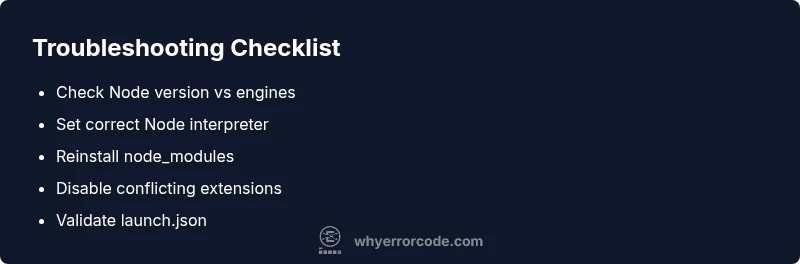
- Verify Node.js and npm versions align with engines in package.json. 2) Set the correct Node interpreter in VS Code and ensure it points to the intended installation. 3) Delete node_modules and reinstall dependencies with npm install or yarn install. 4) Disable extensions to isolate conflicts; restart VS Code or run code --disable-extensions. 5) Review and fix launch.json to ensure the runtime and program paths are correct. 6) Reproduce in a clean workspace to confirm the issue isn’t project-specific. 7) If needed, escalate with logs and environment details to a senior dev or open an issue with reproducible steps.
Tips and warnings to avoid safety issues
- Pro tip: Always back up your settings before making changes to VS Code configuration. - Warning: Do not run npm install or alter dependencies on a production server without tests and backups. - Note: Keep a change log of debugging steps and environment changes to simplify future troubleshooting.
Best practices and prevention tips
To prevent repeat occurrences of the vs code javascript error, standardize your development environment using a version manager like nvm and align local Node versions with your project's engines. Maintain clean workspaces by isolating projects, and adopt a minimal VS Code setup for debugging. Document your debug configurations and create a small, shareable reproduction whenever you encounter unfamiliar errors. Regularly prune extensions and reset your workspace when issues accumulate.
How to read error messages and logs effectively
Mastery comes from reading error traces efficiently. Focus on the first relevant line in the stack trace that points to your code or a dependency. Cross-check that file path exists in your project and verify whether the error originates from the runtime (Node) or the transpilation layer (Babel, TypeScript). Use gists or snippets of the error to search for known fixes, and capture a reproducible scenario. This skill accelerates troubleshooting and reduces trial-and-error time when facing a vs code javascript error.
Steps
Estimated time: 45-60 minutes
- 1
Check runtime versions
Open the terminal and run node -v and npm -v to confirm versions. Compare these with your package.json engines and project docs. If mismatched, install the required version or switch using a version manager.
Tip: Use nvm to switch Node versions per project. - 2
Verify VS Code interpreter
Ensure VS Code uses the intended Node interpreter for your workspace. If necessary, set the path in settings or use a local installation for consistency across machines.
Tip: Keep a consistent Node path in the repo. - 3
Refresh dependencies
Delete node_modules and run npm install to refresh dependencies. If you use yarn, run yarn install. This eliminates corrupted modules causing runtime errors.
Tip: Delete lockfiles if the install diverges from expectations. - 4
Isolate extensions
Disable all extensions and re-enable them one by one to identify conflicts. Start VS Code with --disable-extensions for a clean baseline.
Tip: Test with a minimal extension set first. - 5
Check launch/debug configuration
Open .vscode/launch.json and verify program paths, runtimeExecutable, and arguments. A misconfigured debug setup often triggers false errors.
Tip: Create a small, minimal debug config to reproduce. - 6
Reproduce in a clean workspace
Copy the project to a new folder and open it in a fresh VS Code instance to see if the issue persists. If not, the problem is workspace-specific.
Tip: Avoid copy-pasting heavy caches; use a clean clone. - 7
Escalate with logs
If the error remains, collect error messages, stack traces, environment details, and steps to reproduce. Share them with a teammate or open an issue with clear reproduction steps.
Tip: Capture exact terminal output and file paths.
Diagnosis: Error message appears when running JavaScript/TypeScript in VS Code
Possible Causes
- highNode.js version mismatch with project requirements
- highIncorrect or missing interpreter in VS Code
- mediumConflicting extensions or corrupted VS Code settings
- mediumBroken node_modules or incorrect npm/yarn install
- lowLaunch.json or debug configuration errors
Fixes
- easyCheck node -v and ensure it matches engines in package.json; install/use the correct version
- easySet the Node.js interpreter path in VS Code settings or via a version manager like nvm
- easyDisable extensions to isolate conflicts or start VS Code with --disable-extensions
- easyDelete node_modules and reinstall dependencies (npm install or yarn install)
- mediumReview and fix launch.json to ensure the program/runtime path is correct
Frequently Asked Questions
What is the most common cause of a vs code javascript error?
The most common causes are Node.js version mismatches, an incorrect interpreter path in VS Code, or conflicting extensions. Verifying versions, interpreter configuration, and a clean workspace usually resolves the issue quickly.
The most common causes are Node.js version mismatches, interpreter setup, or conflicting extensions. Check versions, set the right interpreter, and test in a clean workspace.
Why do I get 'Cannot find module' in VS Code?
This typically means node_modules is missing or not installed correctly. Run npm install, verify package.json dependencies, and ensure the module is listed in your project. A fresh install often fixes it.
Cannot find module usually means node_modules is missing or not installed correctly. Run npm install and verify dependencies.
How can I safely disable extensions to troubleshoot?
Use the Extensions view to disable all installed extensions, then re-enable them one by one, testing after each enable. You can also launch VS Code with --disable-extensions for a baseline check.
Disable all extensions to test baseline, then re-enable one by one to find the culprit.
Should I always restart VS Code after changes?
Yes. Many changes, especially to interpreter paths or extensions, require a restart to take effect. Restarting ensures the new configuration is loaded.
Restart VS Code after changes to ensure new settings take effect.
When should I escalate to professionals?
If the error persists after a structured debugging flow, collect logs and environment details, and seek help from a teammate or supervisor who can review the environment and project-specific configurations.
If it still won’t fix, collect logs and ask a teammate to review with you.
What logs are most helpful for troubleshooting?
Helpful logs include the terminal output, stack traces, the contents of launch.json, and information about installed extensions. Sharing reproducible steps helps others diagnose faster.
Share terminal output, stack traces, and reproducible steps to help others diagnose quickly.
Watch Video
Top Takeaways
- Verify Node version aligns with engines.
- Isolate extensions to identify conflicts.
- Check launch.json and debug configuration carefully.
- Use a clean workspace to confirm project-specific issues.