What to Do with Error Code: A Practical Troubleshooting Guide
A comprehensive, step-by-step approach to diagnosing and resolving error codes across software, hardware, and networks with a repeatable troubleshooting playbook.


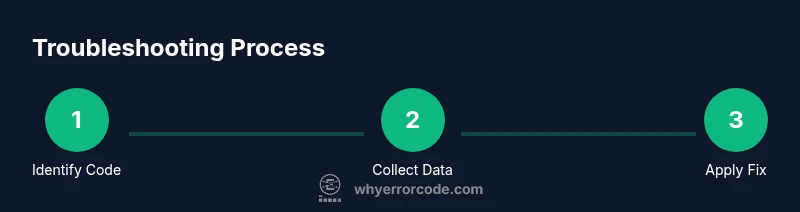
Goal: resolve error code quickly by following a repeatable process. You’ll learn how to identify the context, gather data, apply proven troubleshooting steps, and verify a fix. This quick guide outlines a practical, step-by-step approach for covering software, hardware, and network error codes. According to Why Error Code, starting with a structured playbook accelerates resolution.
Understanding What an Error Code Means
An error code is a compact signal that tells you where a problem originated and what type of failure occurred. Understanding the distinction between the code itself and the accompanying text message is crucial. The code is the pointer; the message is context. When you ask what to do with error code, your first goal is to decode what the code implies about the subsystem, the operation you were attempting, and the environment. In practice, you’ll group codes into families: software/application, operating system, network, and hardware/firmware. Each family has its own documentation style, so cross-check multiple sources to avoid misinterpretation. According to Why Error Code, start from a standard taxonomy: identify the affected layer (UI, API, database, or hardware interface), note any recent changes, and correlate with the exact time and user actions. With that foundation, you can craft a focused, repeatable plan rather than chasing vague symptoms.
Gather Data Before You Troubleshoot
Before touching anything, collect essential data that will drive your decisions. Record the exact error code and any text that accompanies it, the time of occurrence, and the system or device involved. Capture the user actions that led to the error and any recent changes (deploys, configuration updates, or firmware upgrades). Gather relevant logs, screenshots, and telemetry. If you’re dealing with software, pull logs from the application, server, and client; for hardware, note sensor readings and diagnostic outputs. Build a quick checklist so you don’t miss a detail. Create a safe, isolated environment if you need to reproduce the error; never test fixes in production. By compiling this information upfront, you can quickly identify patterns, rule out noise, and narrow the root cause to a specific component or module. This disciplined data collection aligns with Why Error Code’s recommended troubleshooting mindset.
Quick Checks to Rule Out Common Causes
Some failures are caused by simple, reversible issues. Start with a quick battery of checks that apply across many contexts:
- Is the error code reproducible in a controlled environment? If not, investigate environmental factors rather than the code path.
- Are there recent changes that could have destabilized the system? Roll back if feasible.
- Do you have proper permissions, credentials, or licensing in place? A missing entitlement often surfaces as a code.
- Is the device or service accessible? A network problem can masquerade as an internal fault.
- Do resources (memory, disk, bandwidth) appear healthy? Resource exhaustion is a frequent root cause.
Document every check and its result. If a check eliminates a class of causes, you gain confidence to move forward rather than guessing. This approach reflects the practical, methodical style that Why Error Code champions.
How to Interpret Common Error Code Families
Error codes fall into families that hint at root causes. Here’s how to map them to actionable steps:
- Software/OS codes: Often indicate permissions, invalid inputs, or missing dependencies. Check stacks, call traces, and recent releases.
- Network codes: Look for connectivity, DNS, and TLS issues. Verify endpoints, certificates, and firewall rules.
- Database or API error codes: Examine query integrity, schema compatibility, rate limits, and auth tokens.
- Hardware/firmware codes: Correlate with sensor status, power cycles, and firmware versions. Physical interventions may be warranted.
Cross-reference your code with vendor or platform documentation to confirm its meaning. If the official doc is ambiguous, search for community discussions around the same code and version. The goal is to translate a numeric glyph into a concrete next step, not to linger on the symbolism. Why Error Code emphasizes using a standardized interpretation approach to avoid misclassification.
Collect Logs, Screenshots, and Telemetry
Collection is the backbone of successful troubleshooting. Save external context such as user locale, time zone, and device model. For software, export logs in a structured format (JSON, CSV) and include the exact time window you observed the error. Take screenshots of error dialogs and stack traces. If you can reproduce the issue, capture a screen recording that shows the steps leading to the failure. Telemetry can include CPU load, memory usage, network latency, and error rates. Centralize this data in a shared repository so teammates can access it. When you present the data to teammates or vendors, a consistent format helps them understand the issue quickly, reducing back-and-forth questions. The goal is to remove ambiguity and create a shared, auditable trail for root cause analysis.
Apply a Safe, Repeatable Troubleshooting Protocol
Adopt a stepwise protocol that minimizes risk and maximizes learning. Start by isolating the subsystem most likely to be involved, and avoid risky, invasive changes without sign-off. Use a controlled test plan and a rollback strategy. Implement the smallest possible fix that tests the hypothesis, then verify it across the affected environment. If the issue persists, escalate with the collected data rather than retrying blind remedies. Always document deviations from the plan and outcomes to improve future iterations. This structured approach aligns with Why Error Code’s framework for sustainable troubleshooting, reducing the chance of regressions and repeating the same mistakes.
Verifying a Fix and Preventing Recurrence
Verification ensures we’re not just masking a problem. After applying a fix, re-run the exact steps that reproduced the error and confirm the code no longer triggers. Monitor related metrics to detect regressions and watch for similar errors across other environments. Implement regression tests or automated checks where feasible, and update any affected runbooks. To prevent recurrence, close the loop with documentation: what changed, why, and how it was validated. If the root cause was a configuration drift, implement guardrails or automated configuration management to enforce consistency. Communicate findings with stakeholders so the team learns from the incident. The Why Error Code methodology emphasizes a feedback loop that strengthens resilience and reduces the likelihood of repeated failures.
Tools, Resources, and When to Escalate
Choose tools that fit your stack and are easy to audit. Use log aggregators, debuggers, and network analyzers to gather data efficiently. Keep a ready list of vendor documentation, community forums, and official status pages for quick cross-reference. When to escalate: if the error code remains unexplained after 1-2 rounds of local troubleshooting, or if production risk is high, involve senior engineers or incident response if applicable. Maintain a decision log: who decided what, when, and why. Escalation should be time-bound and data-driven, not reactive. For repeatable guidance, weave this process into your team’s playbooks and runbooks. Why Error Code also recommends training on effective communication with vendors and internal teams to speed resolution and preserve credibility.
Build a Personal Troubleshooting Playbook for Your Team
Create a living document that your team can reference during incidents. Start with a blank template that includes sections for error code, context, steps taken, evidence collected, and outcomes. Populate it with your experiences and a growing library of known issues. Schedule regular reviews to retire stale guidance and incorporate new learnings. Assign ownership for each error category so improvements are continuous. Include templates for incident reports, postmortems, and knowledge base articles. The playbook should emphasize safety, version control, and reproducibility. Finally, rehearse the process with table-top exercises to improve response times and reduce confusion in live events. The Why Error Code team endorses a culture of proactive learning, because every resolved error becomes a blueprint for preventing future outages and accelerating repair times.
Tools & Materials
- Error code reference sheet(Include code, meaning, and suggested actions)
- Log capture tool(Export logs from application, server, and client)
- Environment details sheet(OS, version, hardware, network context)
- Screenshots/screen recording tool(Capture error dialogs and stack traces)
- Text editor or note-taking app(Document steps and outcomes)
- Safe test environment(Replicate issues without impacting production)
Steps
Estimated time: 1-3 hours depending on complexity
- 1
Identify the error code and context
Note the exact code, accompanying message, and the subsystem involved. Capture the user action that triggered the error and any recent changes. This step anchors the investigation and prevents misinterpretation.
Tip: Write the problem statement in one sentence; this clarifies scope before you proceed. - 2
Reproduce the issue safely
Create a controlled scenario that reliably triggers the error in a non-production environment. Document the steps, inputs, and outcomes to ensure reproducibility and traceability.
Tip: Use synthetic data or a staging instance to avoid production impact. - 3
Collect all relevant evidence
Gather logs, telemetry, screenshots, and configuration details covering the time window of the error. Centralize artifacts in a shared location for easy access by teammates or vendors.
Tip: Time-align all artifacts to the same clock source. - 4
Consult documentation and previous incidents
Check official docs and existing knowledge bases for the exact code and version. Review postmortems or forums for similar occurrences and proven fixes.
Tip: Search by the code plus your version or environment to improve relevance. - 5
Isolate the most likely subsystem
Map the code to a module or service. Verify whether the fault trace points to a specific component rather than the entire system, reducing blast radius.
Tip: Limit changes to a single component to preserve testability. - 6
Apply a safe, minimal fix or workaround
Implement the smallest change that tests your hypothesis. Prefer configuration tweaks or code-local fixes with rollback options.
Tip: Document why this fix was chosen and how you validated it. - 7
Validate the fix with full testing
Re-run the reproduction steps and execute smoke and regression tests to confirm no new issues were introduced. Monitor related metrics for any side effects.
Tip: Automate the test where possible to prevent human error. - 8
Document, share, and update the playbook
Record exactly what changed, how it was verified, and the rationale. Update runbooks and knowledge bases to help future incidents.
Tip: Schedule a quick team review to consolidate learning.
Frequently Asked Questions
What exactly is an error code and how should I read it?
An error code is a symbolic value returned by a system to indicate a specific failure. Read it alongside the message to identify the subsystem and potential root causes. Always refer to official docs for precise meaning and recommended actions.
An error code signals a specific failure. Read it with the message to identify where it came from and what to check next.
How do I start troubleshooting quickly?
Start by noting the code and context, collecting logs, and reproducing the issue in a safe environment. Use a repeatable protocol and check official docs for the exact meaning before trying changes.
Start by recording the code and context, gather logs, and reproduce safely to guide your next steps.
When should I escalate the issue?
Escalate when the code is unexplained after initial checks, or if production risk remains high. Involve senior engineers and incident response with the collected data and a clear replication path.
Escalate if you’re not making progress after initial steps or if the production risk is high.
Are error codes universal across systems?
No. Error codes vary by system, vendor, and version. Always consult the relevant documentation and cross-reference with community discussions for the same environment.
Codes vary by system; check the right docs for your version and context.
What should I collect before contacting support?
Collect the exact code, text message, environment details, recent changes, and evidence (logs, screenshots, telemetry). This helps support reproduce and triage faster.
Gather the code, context, environment details, and evidence before contacting support.
How long does a typical fix take?
Fix times vary with complexity, environment, and availability of documentation. Use a staged plan with clear milestones and communicate progress with stakeholders.
Fix time depends on complexity; plan with milestones and communicate progress.
Watch Video
Top Takeaways
- Identify the exact code and context.
- Collect comprehensive evidence before acting.
- Isolate the likely subsystem to narrow scope.
- Apply minimal, testable fixes with rollback plans.
- Document outcomes to prevent recurrence.